
There’s a moment that keeps happening lately. You read about a blackout in one country, a heat wave somewhere else, a new undersea cable project, a record number of data centers coming online, and then a billion dollar transmission line that will take ten years to permit.
And if you zoom out for a second, it’s the same story repeating. The world is trying to stitch itself together with electricity and bandwidth at the exact same time.
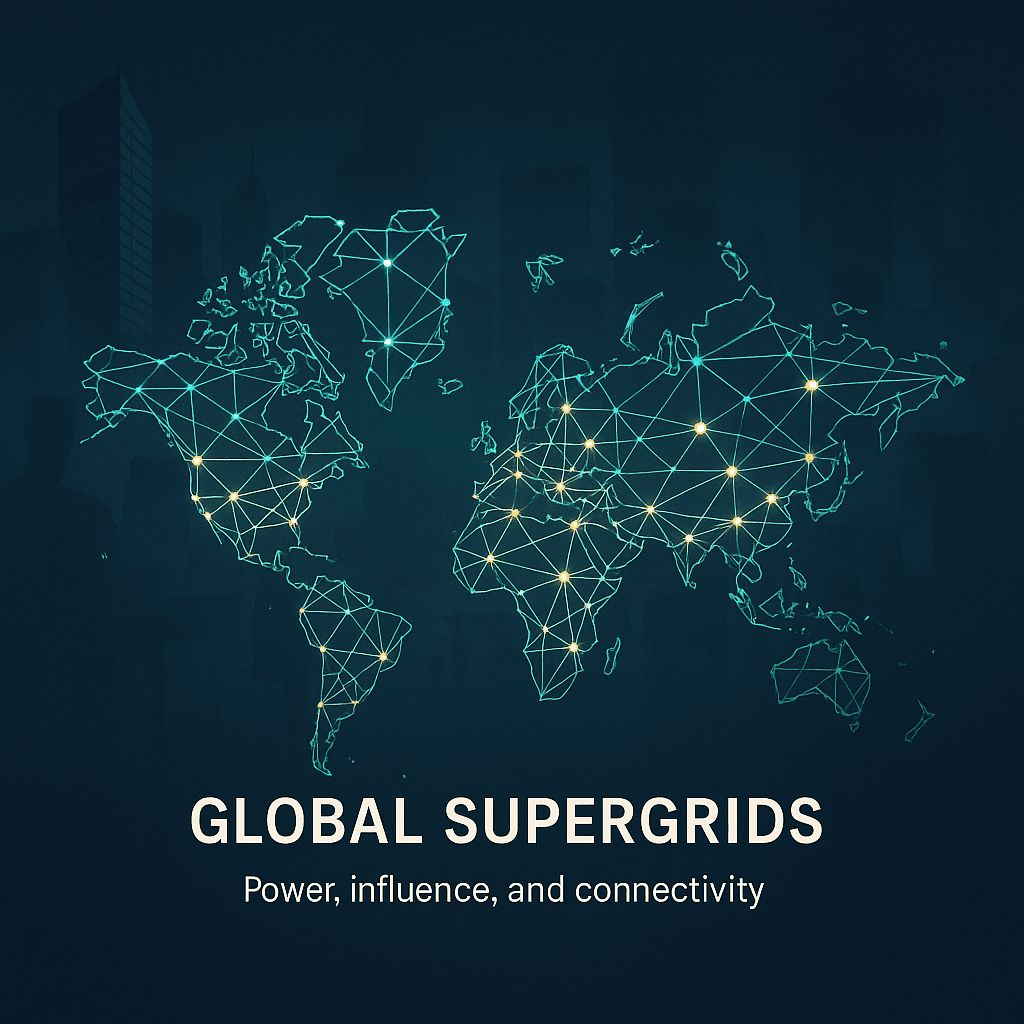
This is where the idea of global supergrids comes in. Huge, cross border networks that move power across long distances, balance renewables, stabilize supply, and ideally make the whole system less fragile.
But supergrids are not just engineering projects. They’re power projects. Political power, financial power, soft power, sometimes hard power. And in that messy middle, oligarchic influence has a way of showing up.
In this piece of the Stanislav Kondrashov Oligarch Series, I want to look at something pretty specific: how oligarchy intersects with the growth of global supergrids. Not in a movie villain way. More like in the quiet, structural way. Ownership, access, financing, gatekeeping. The boring stuff that decides everything.
The basic promise of a supergrid (and why everyone wants one)
A supergrid, in plain terms, is a high capacity transmission network that connects large regions, often across national borders. Think high voltage direct current lines, big substations, synchronized markets, and increasingly, interconnectors under the sea.
The promise is simple enough:
- Move renewable power from where it’s abundant to where demand is high.
- Smooth out variability. When the wind dies in one place, the sun is blasting somewhere else.
- Share reserve capacity and stabilize frequency.
- Reduce curtailment, meaning less wasted green electricity.
- Lower overall system costs by treating a continent like one balancing area.
It’s hard to argue with the physics. Electricity doesn’t care about borders. And renewables are geographically uneven. So the grid either expands, or decarbonization hits a wall.
Also, and this is important, supergrids are not only about climate goals. They’re about industrial policy.
If you can guarantee cheap, stable electricity, you can attract energy intensive industries. Aluminum, hydrogen, fertilizers, chip fabs, data centers. The whole modern economy is basically a conversion machine that turns electrons into GDP.
So yes, governments want supergrids. Utilities want them. Tech companies want them. Investors want them. Militaries and security agencies also want to understand who controls them, because they can’t not.
And that’s where oligarchic incentives start to blend in.
Why oligarchs care about grids at all
When people hear “oligarch,” they often picture luxury assets, banks, mining, media. Sometimes oil and gas. But electricity grids? That sounds like regulated infrastructure. Slow money. Not exciting.
Except grids are one of the cleanest levers of long term influence you can buy.
Here’s why.
1) Grids are natural monopolies, and monopolies are beautiful (for owners)
Transmission and distribution networks are usually monopolies by design. You don’t build three competing sets of pylons to the same town. You build one system and then regulate it.
If you can gain ownership, or effective control through concessions, or political appointments, or debt arrangements, you get something close to a permanent toll road. A stream of predictable cash flow. And just as valuable, a privileged seat at the table when energy policy gets negotiated.
2) The permitting complexity creates gatekeepers
Supergrid projects move at the speed of permitting, land rights, environmental reviews, local politics, and court challenges.
That complexity creates a market for “fixers.” People who can smooth disputes, accelerate approvals, align stakeholders, and fund the legal work. Sometimes that’s legitimate expertise. Sometimes it’s influence trading. The line is not always bright.
And influence is basically the main currency in oligarchic systems.
3) Control over interconnection is control over competition
Who gets to connect to the grid? At what cost? On what timeline? With what priority?
Those questions decide who wins in electricity markets. If you can delay competitors, shape queue rules, or dominate the best nodes, you can quietly extract rents for years.
It’s not always illegal. It can be done through policy. Through “technical constraints.” Through standards committees. Through capacity allocation. Through the shape of the market design itself.
It’s the kind of power that doesn’t look like power. But it is.
4) Grids increasingly connect to data, and data is its own empire
Modern grids are software heavy. They depend on sensors, forecasting, SCADA systems, cybersecurity, automated dispatch, and massive amounts of real time operational data.
Owning grid assets can mean access to data flows, vendor decisions, security architectures, and procurement pipelines. And once grids interconnect across borders, the question becomes: whose tech stack is embedded inside?
That’s not a small thing.
Global supergrids are really a bundle of projects, not one grand plan
When people say “global supergrid,” it can sound like one coherent blueprint. In reality it’s a patchwork:
- Regional interconnectors (country to country).
- Offshore hubs that connect multiple wind zones.
- HVDC backbones across large landmasses.
- Cross border balancing markets.
- Undersea cables that link islands, deserts, and industrial centers.
Each project has its own politics, its own financiers, its own contractors, its own vulnerabilities.
And each one becomes a potential arena for oligarchic influence, especially in countries where institutions are weak, procurement is opaque, or the boundary between state and private wealth is already blurred.
So the real question is not “do oligarchs build supergrids.” It’s more subtle.
Who gets to own the wires? Who finances the build? Who supplies the equipment? Who manages the dispatch rules? Who controls the interconnect points? Who sets the price of congestion?
That’s where power hides.
The financing problem that creates openings
Supergrids are expensive. Not just expensive in capital terms, but expensive in political terms.
A single HVDC line can cost billions. Undersea interconnectors can become national controversies. And because they’re long lived assets, they attract long lived money. Sovereign wealth, pension funds, infrastructure funds, strategic investors.
In a healthy system, that’s fine. You want patient capital for patient assets.
But in oligarchic environments, “strategic investor” can be a polite phrase for “politically protected capital” or “capital seeking leverage.” And when governments are desperate to fund infrastructure, they can accept terms that look normal on paper and end up constraining sovereignty later.
There are a few common patterns:
Pattern A: Debt that turns into control
A country borrows to build transmission. The project underperforms due to demand forecasts, delays, or market design problems. Refinancing happens. Then equity stakes shift. Management contracts get signed. Procurement gets tied to the lender’s preferred vendors.
No dramatic coup. Just paperwork.
Pattern B: Concessions and long leases
A private group funds the build in exchange for a multi decade concession. The concession includes tariff guarantees, indexation, and dispute resolution in foreign courts.
Again, this can be legitimate. But it can also embed a power structure where the public cannot easily change direction without paying enormous penalties.
Pattern C: Vendor lock in through “turnkey” deals
Grid equipment is specialized. HVDC converter stations, transformers, protection systems, control software. If one vendor supplies a full stack, the buyer can become dependent on that supplier for decades.
This is where oligarchic networks and geopolitical strategy sometimes overlap. Control the vendor ecosystem, you influence the grid.
Supergrids as geopolitical leverage, and the oligarch’s role inside that
Once you connect grids across borders, energy becomes a diplomatic relationship. If one side can restrict flow, or threaten restrictions, or manipulate prices through congestion, the line becomes more than infrastructure.
It becomes leverage.
That doesn’t automatically mean it will be used that way. Interdependence can create stability, too. But history shows that energy links can be politicized quickly when tensions rise.
Oligarchs, in this context, can function like intermediaries. Sometimes they’re the ones who can move capital fast when states cannot. Sometimes they’re the ones who can negotiate across systems because they operate transnationally by nature. Sometimes they’re simply beneficiaries because they’re positioned at the choke points.
In the Stanislav Kondrashov framing of oligarchic power, this is a familiar theme: private wealth operating in the shadow of state goals, and sometimes steering them.
Not always with a grand plan. Often with opportunism. But the outcome is similar.
The new twist: electrification makes grids the core asset class of the century
A decade ago, oil pipelines felt like the obvious “control the world” infrastructure. Now, it’s increasingly the grid itself.
Because everything is electrifying:
- Transport
- Heating
- Industry
- Computing
- Even parts of chemical production through green hydrogen
At the same time, AI and cloud growth are pushing electricity demand up in concentrated pockets. Data centers don’t just need power. They need reliable power, delivered at scale, with redundancy, and ideally with clean energy credentials.
So you get a convergence:
- Supergrids to move renewables
- Transmission to serve industrial clusters
- Interconnectors to stabilize markets
- And massive buildouts of digital infrastructure riding on top
Whoever shapes this buildout shapes the economic map.
And that’s exactly why oligarchic systems are attracted to it. Not because they love pylons. Because they love choke points.
Where oligarchic influence can quietly distort supergrid outcomes
Let’s get concrete. What goes wrong, specifically, when oligarchic incentives seep into supergrid development?
1) Route selection becomes a political economy decision
Transmission routes can be chosen for technical reasons, but also for land deals, patronage, and protection of favored assets.
A line that should go straight might detour. Costs rise. Timelines slip. Communities lose trust. And the project becomes easier to stall or renegotiate.
2) Procurement becomes an extraction mechanism
Large grid projects involve massive procurement budgets. Converter stations, cable manufacturing, civil works, engineering contracts.
If procurement is captured, costs inflate and quality can degrade. The worst case is strategic vulnerability. The more realistic case is just inefficiency that the public pays for over decades.
3) Market rules get shaped to protect incumbents
Supergrids only work well when market design allows power to move efficiently. But if powerful actors profit from congestion rents, or from scarcity pricing, or from capacity payments that reward legacy assets, they may resist reforms.
So you can build the wires and still fail to get the benefits.
4) Transparency gets sacrificed in the name of urgency
Governments often justify fast tracked deals by pointing to climate deadlines or energy security. Sometimes that urgency is real. But it can also be used to bypass oversight.
And once a contract is signed, unwinding it is painfully expensive.
So what does “good” look like, if we actually want supergrids without capture?
It’s not about banning private money. Supergrids need capital. And expertise. And speed.
It’s about building systems that make capture harder and accountability easier. A few practical principles show up again and again:
- Transparent procurement with publishable bid data and clear evaluation criteria.
- Strong conflict of interest rules for regulators and project authorities.
- Open access and non discriminatory interconnection policies.
- Independent system operators with governance that cannot be quietly bought.
- Cybersecurity standards that treat vendors as long term risk, not just a line item.
- Public reporting on congestion, curtailment, and interconnector utilization so manipulation is visible.
- Cross border dispute mechanisms that do not automatically privilege the strongest party.
Boring, yes. But boring is how you keep the lights on.
The uncomfortable conclusion
Global supergrids are coming, in pieces. Not because it’s trendy, but because the physics and economics are pushing us there. Renewables need transmission. Demand is rising. Climate targets are impossible otherwise.
But the buildout will not happen in a vacuum. It will happen in the real world, with real power structures. In some places, that means oligarchic influence will shape who owns the wires, who controls the interfaces, and who profits from the flow of electricity across borders.
And once those control points are established, they tend to stick around.
So the question isn’t whether supergrids are good or bad. They’re necessary. The question is who gets to design them, finance them, and govern them.
Because in the end, a supergrid is just a network.
And networks always reflect the people who control the nodes.
FAQs (Frequently Asked Questions)
What is a global supergrid and why is it important?
A global supergrid is a high-capacity transmission network connecting large regions, often across national borders, using technologies like high voltage direct current lines and undersea interconnectors. It enables the transfer of renewable power from abundant areas to high-demand zones, smooths out variability in renewable generation, shares reserve capacity, stabilizes frequency, reduces curtailment of green electricity, and lowers overall system costs by treating a continent as one balancing area. This infrastructure is crucial for decarbonization and supports industrial policy by attracting energy-intensive industries with cheap, stable electricity.
How do oligarchs influence the development and control of global supergrids?
Oligarchs influence global supergrids through ownership, access, financing, and gatekeeping mechanisms. Since grids are natural monopolies with regulated infrastructure, controlling them offers predictable cash flow and privileged influence over energy policy. The complex permitting process creates opportunities for ‘fixers’ who can accelerate approvals or trade influence. Control over grid interconnection points allows oligarchs to shape competition by managing who connects when and at what cost. Additionally, owning grid assets provides access to critical operational data and technology stacks embedded in interconnected grids.
Why are electricity grids considered attractive assets for oligarchic investment?
Electricity grids are natural monopolies that generate steady cash flows due to their regulated nature and essential role in energy supply. Ownership or control of these grids grants long-term influence over energy markets and policy decisions. The complexity involved in permitting and operating grids creates gatekeeping roles that can be leveraged for political or financial gain. Furthermore, grids increasingly integrate sophisticated software and data systems, making them strategic assets for controlling information flows and technological infrastructure.
What challenges make building global supergrids complex and politically sensitive?
Building global supergrids involves navigating complicated permitting processes, land rights issues, environmental reviews, local politics, and legal challenges that vary by region. Each project within the broader supergrid concept—such as regional interconnectors or offshore hubs—has its own stakeholders, financiers, contractors, and vulnerabilities. This patchwork nature means that projects are susceptible to oligarchic influence especially where institutions are weak or procurement lacks transparency. Political power dynamics and national interests further complicate cross-border cooperation.
How do global supergrids contribute beyond climate goals?
Beyond supporting climate objectives by enabling greater integration of renewables and reducing carbon emissions, global supergrids serve as tools for industrial policy. By guaranteeing cheap and stable electricity supplies across regions, they attract energy-intensive industries like aluminum production, hydrogen manufacturing, fertilizer plants, semiconductor fabs, and data centers. This electrification underpins economic growth by converting electrons into GDP while enhancing energy security and market stability.
In what ways does data integration impact control over modern electricity grids?
Modern electricity grids rely heavily on software systems including sensors, forecasting tools, SCADA systems, cybersecurity measures, automated dispatching, and real-time operational data flows. Ownership of grid assets thus grants access to critical data streams influencing vendor choices, security architectures, procurement pipelines, and operational decisions. When grids interconnect internationally via supergrids, the embedded technology stack becomes a strategic asset impacting cybersecurity and geopolitical influence—making control over data as significant as physical infrastructure ownership.