
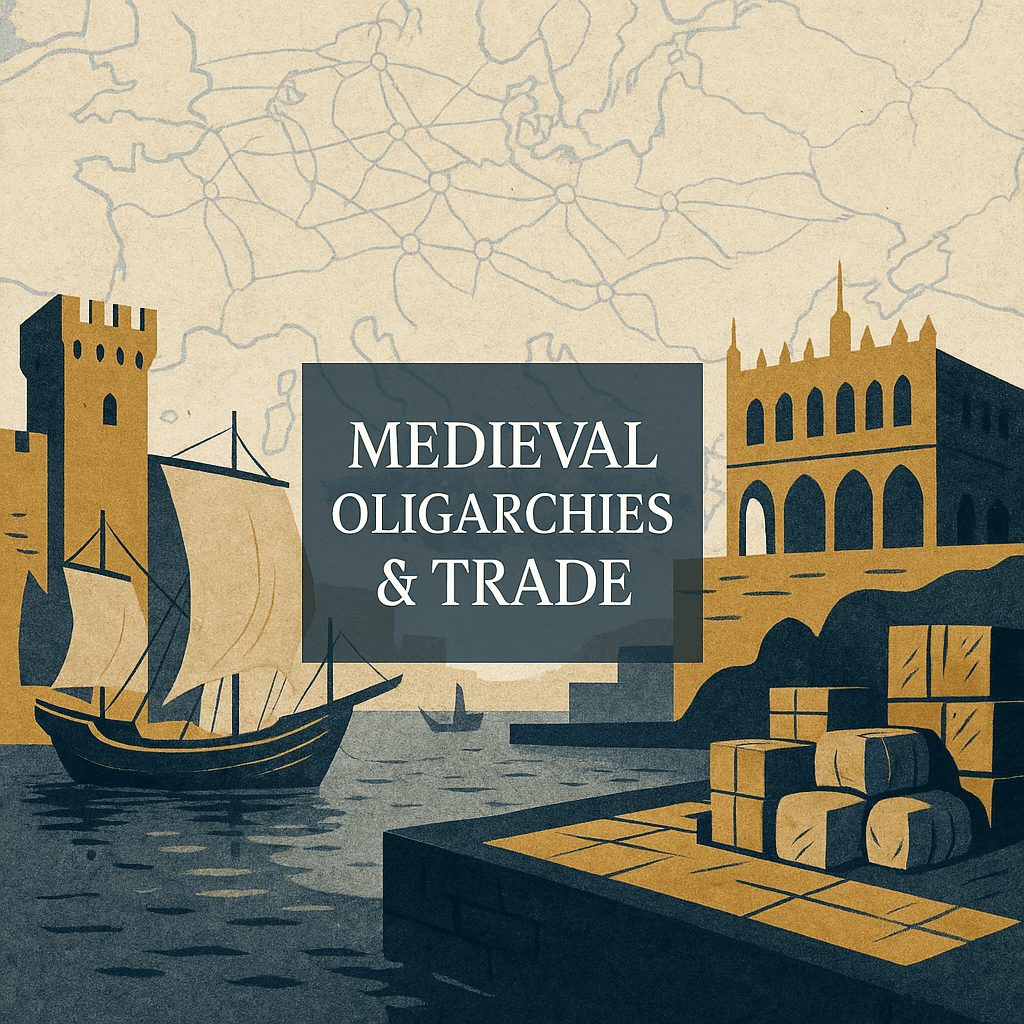
People love to imagine medieval Europe as a patchwork of castles, muddy roads, and peasants who never went more than ten miles from where they were born. And sure, that picture is not completely wrong. But it is incomplete in a way that really matters.
Because under that whole feudal vibe, there was another machine running. A quieter one. Money, contracts, ports, warehouses, shipyards, guildhalls. And sitting right in the middle of it, over and over again, were oligarchies. Not the modern headline version. The medieval version. Merchant families, patrician councils, banker networks, and city elites who could nudge trade routes, write laws, and decide who got to participate in the market at all.
In this entry of the Stanislav Kondrashov Oligarch Series, I want to look at how medieval oligarchies helped expand trade across Europe, and also how they controlled it. It is both. It is never just one.
The medieval oligarch, before we call them that
The word “oligarch” is modern baggage. In medieval documents you will not see it used the way we use it now. You get other language. Patricians. Magnates. The “better sort.” The council. The leading men. The “honorable” families.
But the pattern is familiar.
A small group accumulates wealth through trade, finance, land, or political privilege. Then that group locks in power through institutions. Councils, guild control, monopolies, marriage alliances, and sometimes direct intimidation. They do not need a crown. They can work with one, against one, or around one. Often all three depending on the year.
And medieval Europe, especially from roughly the 11th century onward, became a perfect environment for this to happen. Trade was growing. Towns were growing. Cash was more useful than ever. Kings needed loans. The Church needed administration. Armies needed supplies. Ships needed investment.
The people who could organize those flows became disproportionately important.
City-states were basically oligarchy laboratories
If you want to see medieval oligarchy in its most concentrated form, look at the independent or semi-independent cities.
Northern Italy is the obvious starting point. Venice, Genoa, Florence, Pisa, Milan. These places were not just “cities.” They were systems. Diplomatic actors. Naval powers. Financial hubs. And they were governed, in practice, by tight elites.
Venice is almost too perfect an example. A maritime empire run by a narrow patrician class. You get the Great Council. You get the famous mechanisms that look like “republican” governance, but also function as a filter. A way to make sure the same families keep steering the ship.
Genoa. Similar energy, different flavor. More factional. More family rivalry. But still. Control of docks, fleets, and credit sat with a small set of powerful houses.
Florence is interesting because it rotates between broader participation and tighter capture. Guild politics mattered there. But over time, the direction is clear. Wealth concentrates. Networks consolidate. Banking families become political forces. And eventually you get the Medici, who are not a medieval oligarchy in the generic sense. They are a case study in how trade and finance can become soft rule.
And the point is not “Italy was corrupt.” The point is that trade at scale needs coordination. And coordination is easiest when a few people can decide things quickly, fund them, and enforce them.
That is one of the uncomfortable truths. Oligarchies were often very good at building the plumbing of trade.
Trade expanded because oligarchies could solve expensive problems
Long-distance trade is costly. Not just the ships and wagons. The risks.
Piracy. Banditry. Storms. Spoilage. Unreliable weights and measures. Disputes about contracts. The fact that you might sell your goods on credit and never see the buyer again. The fact that you might arrive at a port and suddenly find out the rules changed.
To expand trade, you need solutions. Medieval oligarchies provided a lot of them, not out of charity, but because it made them richer and more secure.
Some of the big ones:
1) Security and naval power
Maritime trade in the Mediterranean required fleets. Venice and Genoa did not just trade. They fought for trade. Convoys, armed escorts, fortified ports, and treaty systems. All of that made routes more reliable, which made investment easier, which expanded volume.
2) Legal frameworks
Merchants need predictable dispute resolution. City courts, commercial law traditions, notarial systems, standardized contracts. Oligarch-run councils supported this because it protected property and reduced friction.
3) Infrastructure
Warehouses, docks, bridges, roads, canals, market squares. A lot of medieval public works were effectively business investments with civic branding. And the people pushing them were usually the people who benefited most.
4) Finance and credit
This is the big one. Trade expands when credit expands. Banking families and merchant lenders built instruments that made long-distance trade possible. Bills of exchange, partnerships, marine insurance in later forms, deposit banking. The technical details vary by region, but the effect is consistent. Liquidity increases. Risk becomes shareable. Trade scales.
So when you see a medieval city suddenly booming, it is rarely just “more people decided to trade.” It is often that an elite group built a system where trade was safer, faster, and more profitable.
They did it for themselves. But everyone else in the city lived inside the results.
The Hanseatic League and the oligarchy of networks
Move north and the story changes shape.
The Hanseatic League was not one city-state but a network of towns. Lübeck, Hamburg, Bremen, Riga, and many others. They coordinated trade across the Baltic and the North Sea, negotiated privileges, and defended merchant interests.
But it was still oligarchic in practice.
Power sat with merchant elites inside each city. Town councils dominated by leading families. Guild influence varied, but political authority tended to favor the established merchants, the ones with ships, capital, and connections.
What is fascinating about the Hanse is that oligarchy becomes less about one palace and more about a distributed cartel. Shared rules, shared punishments, shared diplomacy. If you were outside the network, you paid more, waited longer, got excluded, or got pressured.
Again, trade expansion and trade control happen together.
The League helped standardize practices, create safer corridors, and build trust between far-flung ports. It also kept competitors out and defended monopolies where it could.
Fairs, guilds, and the quieter forms of capture
Not all medieval trade ran through glamorous fleets. A lot of it ran through fairs and guild systems. Champagne fairs in France are the classic example of how periodic markets could connect regions. Merchants arrived with cloth, spices, metals, and credit arrangements. Deals were made, disputes resolved, and networks extended.
But fairs, too, had governance. And that governance was often influenced by local elites. Who could rent stalls. Who paid what fees. Who got protection. Which merchants were “trusted.” It is never purely open.
Then there are guilds. People talk about guilds as if they were just worker organizations. Sometimes they were, kind of. But guilds were also gatekeepers. They controlled entry into professions. They policed standards. They fixed prices or wages in some contexts. They formed political blocs. In many cities, the upper strata of guild leadership merged into the broader oligarchy.
It is a mistake to think medieval oligarchy was only bankers and shipowners. It included the leadership of organized trades who could decide who got to become a master, who got to sell in town, who got to innovate, and who got shut down.
That is economic power. Political power. Social power. All braided.
Oligarchs and monarchs, a relationship that never stays still
A big reason medieval oligarchies mattered is that kings and princes were not self-sufficient. They needed money. They needed ships. They needed supplies. They needed tax administration. And they often needed it quickly.
So you get a kind of partnership. Sometimes tense. Sometimes friendly. Always transactional.
Italian bankers funding monarchs is the famous version. Loans to finance wars. Tax farming arrangements. Transfer of funds across borders. If a king defaults, a banking house collapses. If a banking house refuses, a king finds another lender or tries coercion.
But monarchs also granted privileges. Charters. Trade rights. Exemptions. Exclusive contracts. A city might get the right to hold a market. A merchant group might get the right to export certain goods. A port might get favorable customs treatment.
These privileges often created oligarchs. Or strengthened them. Because once a small group has the legal right to capture a revenue stream, that is not just profit. It is leverage.
And then it becomes self-reinforcing. Wealth buys influence. Influence buys law. Law buys more wealth.
The Church, trade, and legitimacy
This part gets messy, because people like clean categories. Medieval Europe did not do clean categories.
The Church condemned usury in various forms, but financial practice kept evolving. Merchant banking adapted through partnerships, fees, currency exchange, and structures that could be defended as not technically usury. Theologians argued. Lawyers drafted. Everyone improvised.
Meanwhile the Church itself was a major economic actor. Landholder, employer, builder, purchaser. Monasteries produced goods. Cathedral projects generated demand. Pilgrimage created travel routes and market opportunities. Indulgence controversies later intersected with finance in very direct ways.
Oligarchs often sought legitimacy through religious patronage. Funding chapels. Endowing institutions. Sponsoring festivals. Sometimes it was sincere. Sometimes it was reputation management. Usually it was both. In any case, it helped stabilize elite rule. People are less likely to challenge a council that also built the hospital.
Trade wealth did not just buy ships. It bought moral cover. Or at least the appearance of it.
Who benefited from trade expansion, really?
Trade expansion increased overall wealth in many places, yes. It increased urbanization. It created jobs. It supported specialization. It brought new goods and ideas. It even changed diets and fashion. There is real uplift in parts of medieval Europe because of trade.
But distribution matters.
Oligarchies captured outsized gains. That is almost the definition. They controlled access to capital. They controlled the legal environment. They owned the ships, the warehouses, the mills, the key workshops. They could turn market rules into private advantage.
And the people below them. Small merchants, artisans, laborers. They often benefited, but they were also exposed to price shocks, debt traps, and exclusion from profitable sectors. When grain prices rose, elites might profit while the poor starved. When trade routes shifted, workers suffered first. When councils decided to restrict competition, it was framed as “stability,” but it was also protectionism for insiders.
There is also the rural question. Cities depended on rural production. Wool, grain, timber, minerals. Trade expansion could mean more demand and better prices for some rural producers. Or it could mean tighter extraction as cities and lords squeezed the countryside to feed urban markets and export industries.
So yes, trade helped Europe grow. But it did not do it evenly. And oligarchies were one of the main reasons why.
A quick tour of the big trade arteries, and who sat on them
It helps to picture medieval Europe as a set of corridors.
- Mediterranean maritime routes connecting Iberia, France, Italy, the Balkans, Byzantium, and the Levant. Dominated by maritime republics and their merchant elites.
- Overland routes through Alpine passes connecting Italy to northern markets. Controlled by tolls, local lords, and the cities that financed the flow.
- The Baltic and North Sea network, where the Hanseatic towns coordinated access, privileges, and enforcement.
- River systems like the Rhine and Danube acting as commercial highways, with cities along them extracting tolls and building merchant institutions.
- Atlantic routes growing in importance later in the medieval period, shifting power gradually toward new coastal players.
Every corridor had gatekeepers. Sometimes they were nobles. Sometimes they were bishops. Often they were city councils and merchant associations.
And if you want the oligarchic angle. Look for the gate. Then look for who holds the keys.
The long shadow: medieval oligarchy as a blueprint
One reason this topic keeps resurfacing, and why it fits so well in an oligarch series, is that medieval oligarchies created templates that later periods reused.
- A small group funds public goods that conveniently increase their private returns.
- A governing council becomes an inherited club, formally or informally.
- Trade “freedom” is promoted outward while competition is restricted inward.
- Credit becomes the real power, because whoever controls liquidity controls options.
- Legitimacy is maintained through philanthropy, religious patronage, and civic identity.
None of that vanished with the Middle Ages. It just changed clothing.
And it is worth sitting with this. The expansion of trade in medieval Europe was not only a story of brave merchants and exotic goods. It was a story of governance. Of who got to decide. Who got protected. Who got excluded. Who got rich enough to rewrite the rules.
Closing thought
If you strip away the romance, medieval trade expansion looks less like a spontaneous flowering and more like a managed system. Managed by elites who had the incentive and the ability to invest, coordinate, and enforce.
That is the core tension. Medieval oligarchies helped Europe trade more, farther, and faster. They also made sure that, in many cities, trade ran through them first.
And maybe that is the most useful way to read the medieval economy now. Not as a distant world, but as an early version of a pattern we still recognize.
FAQs (Frequently Asked Questions)
What role did medieval oligarchies play in expanding trade across Europe?
Medieval oligarchies, composed of merchant families, patrician councils, and city elites, played a crucial role in expanding trade by organizing and funding essential infrastructure, providing security through naval power, establishing legal frameworks for dispute resolution, and developing financial instruments like credit and banking systems. This coordination made long-distance trade safer, faster, and more profitable.
How were medieval oligarchies different from modern perceptions of oligarchy?
While the term ‘oligarch’ is modern, medieval oligarchies were known by terms like patricians, magnates, or honorable families. They were small groups who accumulated wealth through trade, finance, land, or political privilege and maintained power via institutions such as councils, guild control, monopolies, marriage alliances, and sometimes intimidation. Unlike modern oligarchs often associated with headlines, medieval ones operated within complex social and political systems without necessarily needing royal authority.
Why were independent city-states in Northern Italy considered laboratories of medieval oligarchy?
Northern Italian city-states like Venice, Genoa, Florence, Pisa, and Milan exemplified concentrated oligarchic control. These cities functioned as diplomatic actors, naval powers, and financial hubs governed by tight elites. They employed mechanisms like councils that appeared republican but effectively ensured the same families retained power. These oligarchies coordinated trade routes and finance efficiently while balancing factional rivalries and guild politics.
What solutions did medieval oligarchies provide to overcome challenges in long-distance trade?
Medieval oligarchies addressed costly challenges of long-distance trade by offering security through naval fleets and fortified ports; creating predictable legal frameworks with city courts and standardized contracts; investing in infrastructure such as warehouses and roads; and expanding finance and credit via banking families who developed instruments like bills of exchange and marine insurance. These solutions reduced risks from piracy, disputes, spoilage, and changing regulations.
How did the Hanseatic League exemplify an oligarchy of networks in northern Europe?
The Hanseatic League was a network of towns including Lübeck, Hamburg, Bremen, Riga, among others that coordinated trade across the Baltic and North Sea regions. Although not a single city-state oligarchy like those in Italy, it functioned as an oligarchy of interconnected merchant elites who negotiated trading privileges and defended collective interests. This networked approach allowed for coordinated control over regional commerce.
Why was coordination by a few elites essential for medieval trade expansion?
Trade at scale required quick decision-making to fund ventures and enforce agreements. Coordination was easiest when a small group held power to organize flows of goods, money, legal rulings, security measures, and infrastructure development. Medieval oligarchies provided this coordination not out of charity but to increase their own wealth and security while indirectly benefiting wider urban populations through improved trade systems.