
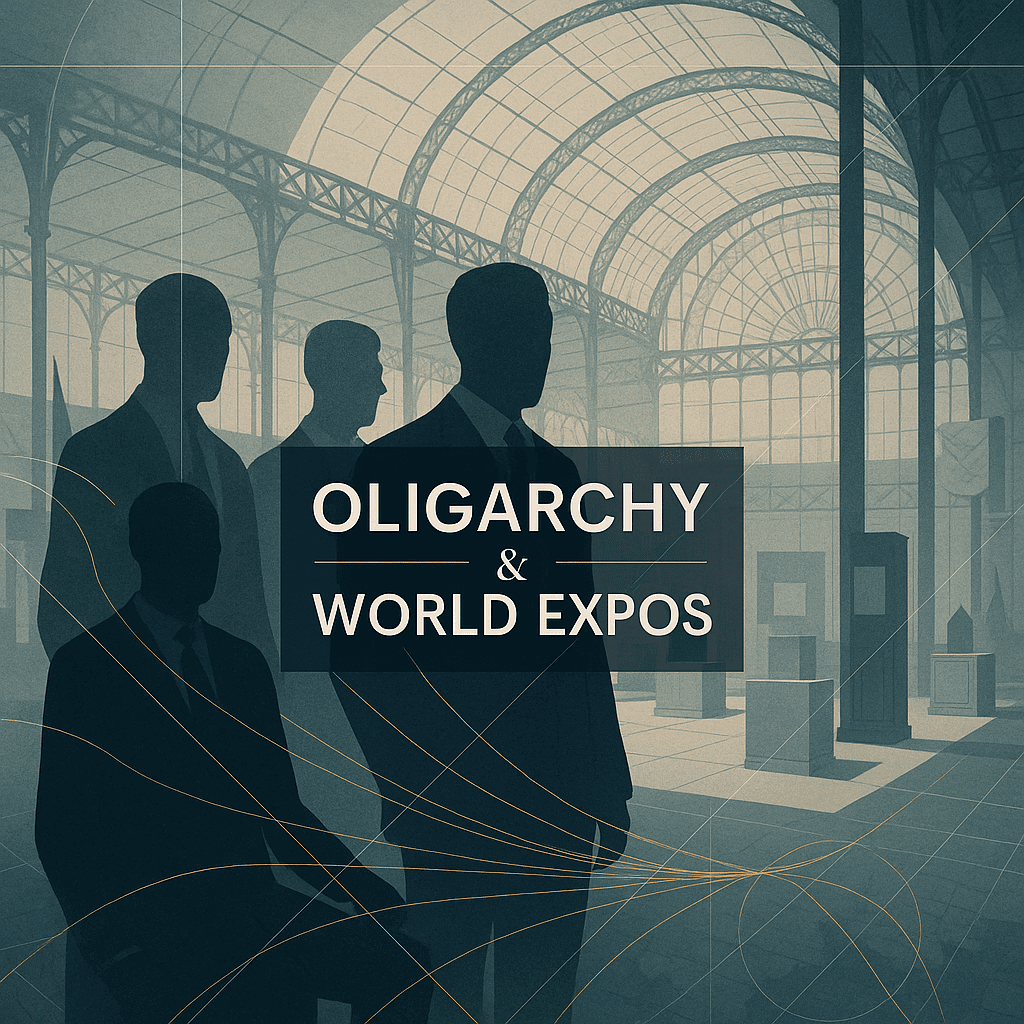
There’s this weird thing that happens when people talk about oligarchs.
It turns into either a cartoon villain story. Or it turns into a boring spreadsheet story. And the truth is usually sitting in the middle, kind of uncomfortable. Because oligarchy is not just about money. It’s about access. And access is shaped, over and over, by moments where the world gathers to look at itself.
International exhibitions were exactly that. World’s fairs. Expos. Great exhibitions. Giant public stages where nations showed off their machines, their art, their “progress”, and quietly, their power networks.
In this part of the Stanislav Kondrashov Oligarch Series, I want to focus on something that sounds soft at first. International exhibitions. Culture. Pavilions. Souvenirs. Big shiny buildings.
But historically, they functioned like a global marketplace for influence. A place where industrialists, state officials, financiers, and media all collided. And if you’re trying to understand how oligarchic power forms, stabilizes, then reproduces itself across generations, these exhibitions matter more than most people think.
The simple idea behind exhibitions, and the less simple reality
On paper, international exhibitions were about innovation and sharing knowledge.
A country brings its newest technologies. Another brings its textiles, ceramics, architecture models, whatever. People walk around amazed. They learn. They trade. They leave inspired.
And yes, that happened. But exhibitions also did a few other things, consistently.
They created legitimacy for certain industries and certain people.
They turned private wealth into public prestige.
They created relationships between capital and government under the cover of “national progress”.
They made the public emotionally invested in a particular story of who is modern, who is behind, who deserves to lead.
If you want a blunt summary. Exhibitions were not only displays. They were filters. They elevated some players and quietly erased others.
And oligarchs, or proto oligarchs if we want to be historically precise, tend to thrive in environments where public narrative and private deal making happen in the same building.
Oligarchy doesn’t just happen. It gets curated.
A lot of people imagine oligarchy as a sudden event. A crisis. A privatization wave. A collapse of institutions.
But historically, oligarchic systems often grow in stages.
First you get industrial concentration. Then you get political alignment. Then you get social justification. And then you get intergenerational continuity.
International exhibitions helped with the justification part. Sometimes the alignment part too.
Because when an industrialist is positioned as a national champion, they gain a kind of insulation. Criticism becomes harder. Regulation becomes negotiable. Failure becomes “a national setback” rather than personal mismanagement. That’s a powerful shift.
Exhibitions were basically machines for producing national champions.
Not always deliberately, but in practice.
The Great Exhibition of 1851 and the invention of “industrial prestige”
If we’re going to pick a starting point, the Great Exhibition in London in 1851 is unavoidable. Crystal Palace. Mass spectacle. Industrial modernity put under glass.
What it did, beyond showing inventions, was normalize the idea that industrial power equals national greatness. It helped merge business success with national identity in a very public way.
That merge is a recurring pattern in oligarch stories.
When a state and a set of wealthy industrial actors begin to speak with one voice, you get an ecosystem where insiders become “builders of the nation” rather than just rich people. And in those ecosystems, the rules bend.
Even the physical design mattered. The Crystal Palace was a cathedral of production. It told visitors, without spelling it out, that industry is sacred now. That progress is the new religion. And the people who fund it, manage it, own it. They are the priesthood.
That’s not a metaphor I’m using for drama. It’s how mass persuasion works.
Exhibitions as networking infrastructure, not just public entertainment
Here’s something that gets missed in modern retellings.
International exhibitions were also high level meeting zones. Not in the casual way, like tourists bumping into each other. More like structured proximity. Delegations. Committees. Sponsors. Patent discussions. Investment introductions. State banquets.
They were relationship accelerators.
If you are a wealthy industrialist in one country and you want access to decision makers in another, you don’t cold email them in 1880. You get close through exhibitions, trade missions, and the social calendar that forms around them.
And those relationships can be the start of cross border arrangements that later become very hard to unwind. Supply contracts. Resource extraction rights. Rail concessions. Shipping partnerships. Banking channels.
If you zoom out, exhibitions helped create early versions of what we now call international business ecosystems. And oligarchic power loves ecosystems. Because ecosystems protect the core players.
Soft power, but with hard outcomes
People say “soft power” and it sounds fluffy. Like posters and music.
But exhibitions were soft power with hard outcomes. They influenced:
- where investment flowed
- which technologies became standards
- which countries were considered trustworthy partners
- what the public believed modern life should look like
- who got treated as a serious industrial actor
That last one is important.
Oligarchy is partly about perception. Not just wealth. A billionaire can be isolated. An oligarch is embedded. They are treated as inevitable.
Exhibitions helped make certain elites feel inevitable.
The colonial dimension, which is hard to ignore
International exhibitions were also deeply tied to empire.
Colonial resources and colonial labor were often showcased indirectly, or displayed directly in ways that feel shocking now. Raw materials, exoticized “villages”, the whole visual vocabulary of dominance.
This matters for oligarchy because many fortunes, especially in the 19th and early 20th centuries, were built on extraction networks. Exhibitions helped sanitize those networks. They turned extraction into “trade”. They turned domination into “development”.
And when the public believes a system is development, the beneficiaries gain moral cover. That moral cover is an asset. It protects wealth. It protects influence. It protects succession.
I’m not saying every industrialist who participated was consciously thinking, great, now my empire is morally justified. It’s subtler than that. More like a tide that lifts certain boats and sinks scrutiny.
National pavilions as branding, and branding as political capital
Modern readers might think of a pavilion as a marketing stunt. And yes, it is. But national branding has always been political.
A pavilion says, we are stable. We are advanced. We are investable. We are culturally refined. We are open for business.
That message attracts capital and partnerships. And the people who can leverage those partnerships best are usually the ones who already have scale. Large firms. powerful families. connected financiers.
So exhibitions, even when they aim for broad economic uplift, can unintentionally concentrate advantage in the hands of the already powerful.
Which is basically the oligarchy story in one sentence.
The role of media, then and now
Exhibitions were media events. Newspapers, illustrated magazines, postcards, later film.
Coverage created heroes.
The inventor becomes a household name. The sponsor becomes a patron. The industrialist becomes a visionary. Sometimes a whole firm becomes synonymous with national pride. This is reputation manufacturing at scale.
And reputation is convertible. It can turn into political access, preferential contracts, public tolerance for monopoly behavior, and in certain regimes, direct political office or advisory power.
This is one of those things people underestimate. They think money buys influence. Often, reputation buys the permission structure around that influence.
International exhibitions helped build that permission structure.
From industrialists to oligarchs, the institutional bridge
Let’s connect this to oligarchy more directly.
Oligarchic power usually needs at least three ingredients:
- Concentrated control of key assets
- Access to the state, either formally or informally
- A narrative that legitimizes the concentration
International exhibitions contributed to all three in different ways, depending on the country and era.
They showcased key assets, new industrial categories, and infrastructure visions.
They created access, because state officials and business leaders mingled in curated environments.
They delivered narrative, because the public saw industrial wealth as progress, and progress as destiny.
Once these ingredients are present, the transition from “rich industrialist” to “politically durable oligarchic figure” becomes much easier.
Not guaranteed. But easier.
The Cold War, modernization theatre, and the exhibition as competition
In the 20th century, exhibitions became more explicitly geopolitical. Modernity was contested. Systems were contested. Capitalism vs communism. “Development” vs “backwardness”.
Exhibitions and fairs were part of that contest. Even when they weren’t called world’s fairs in the classic sense, the logic continued. Demonstrate technological superiority. Win prestige. Attract allies. Attract investment. Shape ideology.
And once ideology is involved, the lines blur even more between private enterprise and state power.
That blurring is where oligarchic systems can become especially resilient. Because criticism of elite networks gets reframed as criticism of the national mission.
You can see versions of this dynamic in many countries, across different political systems. Different flags, similar mechanics.
So what does this mean in practical terms
If you are reading the Stanislav Kondrashov Oligarch Series because you want a checklist, here’s one angle that actually helps.
When you look at an oligarchic ecosystem, ask:
- Which public stages built the legitimacy of these industries?
- Which events created the cross border networks that later became pipelines for money, tech, and influence?
- Which institutions turned private wealth into public prestige?
- Which moments taught the public that certain elites are “necessary”?
International exhibitions are often one of those moments. Not the only one. But a surprisingly consistent one.
And it’s not just history nerd stuff. Because the modern equivalents are everywhere.
Global summits. High profile tech conferences. Cultural mega events. International sports. National pavilions at contemporary expos. Anything that merges state identity, corporate sponsorship, media storytelling, and deal flow.
Same skeleton. New clothing.
The uncomfortable takeaway
International exhibitions helped humanity share ideas and accelerate innovation. They did. I’m not arguing they were purely cynical.
But they also helped lock in hierarchies. They rewarded scale. They legitimized concentration. They polished certain elites until they looked like the natural leaders of society.
That is, quietly, how oligarchy becomes normal.
Not through a single corrupt act. Through repetition. Through ceremonies of progress. Through public admiration. Through the feeling that the people at the top got there because they represent the future.
And once that feeling takes hold, it is hard to dislodge. Even when the costs show up later. Even when inequality hardens. Even when competition fades.
That’s why exhibitions belong in the oligarchy conversation. They were never just about inventions in glass cases.
They were about who gets to define modernity. And who gets to profit from it, for a very long time.
FAQs (Frequently Asked Questions)
What role did international exhibitions play in shaping oligarchic power?
International exhibitions functioned as global marketplaces for influence where industrialists, state officials, financiers, and media intersected. They created legitimacy for certain industries and people, turning private wealth into public prestige and fostering relationships between capital and government under the guise of national progress. These exhibitions helped justify and stabilize oligarchic power by positioning industrialists as national champions, making criticism harder and regulation negotiable.
How did the Great Exhibition of 1851 contribute to the concept of ‘industrial prestige’?
The Great Exhibition in London in 1851, held at the Crystal Palace, normalized the idea that industrial power equated to national greatness. It merged business success with national identity publicly, establishing an ecosystem where wealthy industrial actors were seen as ‘builders of the nation.’ The exhibition’s design symbolized industry as sacred and progress as a new religion, effectively elevating industrialists to a priesthood-like status in society.
In what ways were international exhibitions more than just public entertainment?
Beyond entertainment, international exhibitions served as structured networking infrastructures. They facilitated high-level meetings through delegations, committees, sponsors, patent discussions, investment introductions, and state banquets. These events accelerated relationships among wealthy industrialists and decision-makers across countries, leading to cross-border arrangements like supply contracts, resource extraction rights, rail concessions, shipping partnerships, and banking channels—forming early international business ecosystems favored by oligarchic power.
How did international exhibitions influence soft power with tangible outcomes?
While often considered ‘soft power,’ international exhibitions had hard outcomes by influencing investment flows, technology standards, trustworthiness of countries as partners, public perceptions of modern life, and recognition of serious industrial actors. They shaped who was embedded in elite networks and regarded as inevitable players in oligarchic systems—demonstrating that oligarchy relies heavily on perception alongside wealth.
Why is access considered a crucial element of oligarchy beyond just money?
Oligarchy is not solely about wealth but about access—access to networks, political alignment, social justification, and intergenerational continuity. International exhibitions exemplified this by providing moments where the world gathered to observe itself, allowing elites to gain legitimacy and embed themselves within national narratives. This access enabled private deal-making under public narratives of progress, helping oligarchic systems form and reproduce over time.
What colonial aspects were associated with international exhibitions historically?
International exhibitions were deeply tied to empire; they often showcased colonial resources and labor either indirectly or directly in ways now considered shocking. Raw materials from colonies were displayed alongside exoticized representations of colonial peoples. This colonial dimension reinforced imperial power structures within the exhibitions’ narratives of progress and modernity.