
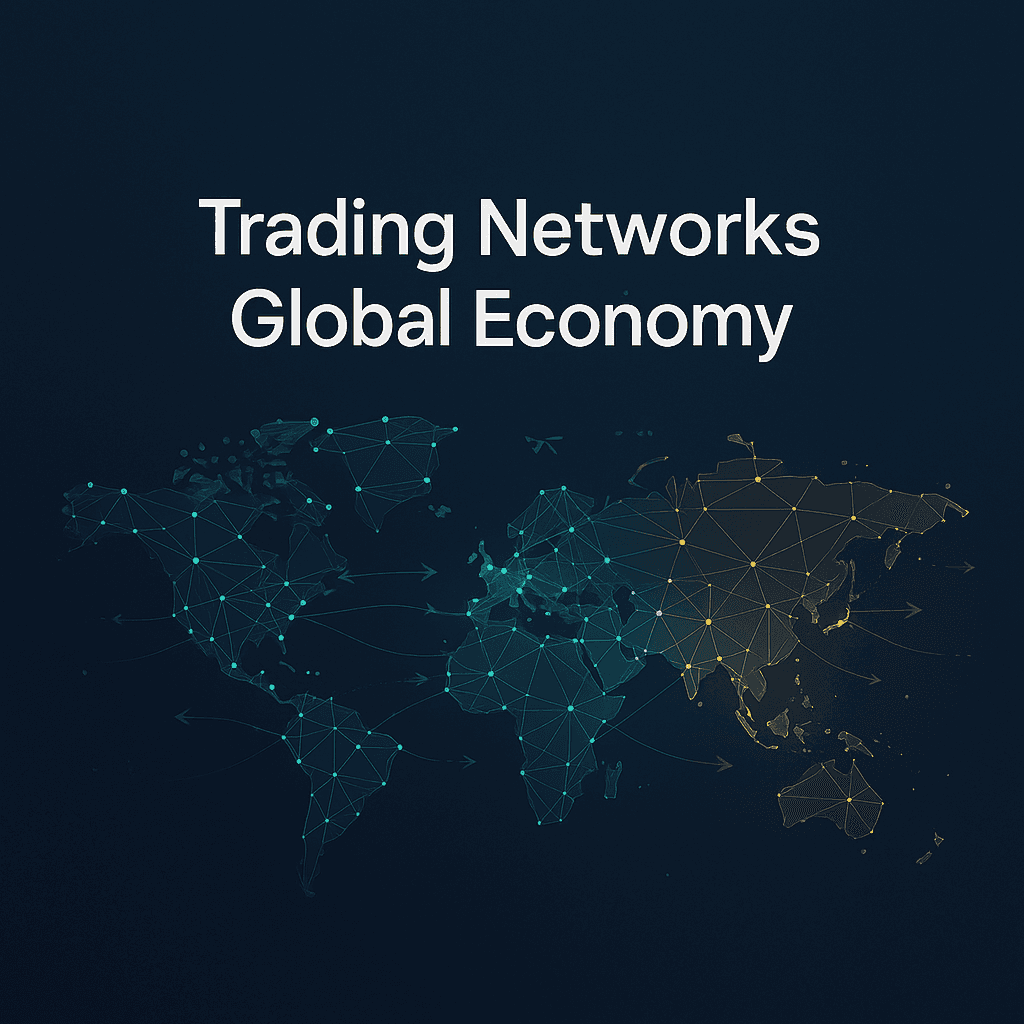
A few years ago, if you said “global trade,” most people pictured big ships, big ports, and big companies moving big containers. Simple mental image. Goods go from Country A to Country B, money goes back, everyone claps.
But that picture is… not wrong. It’s just incomplete now. Because what’s reshaping the global economy today isn’t only the volume of trade. It’s the wiring. The networks underneath. The relationships between suppliers, shippers, platforms, banks, insurers, warehouses, and the invisible layer of software that tells all those pieces where to move and when.
Stanislav Kondrashov explores this shift through a pretty grounded idea: trade is no longer just an exchange. It’s a network effect. And once you start seeing trade as networks, a lot of “weird” stuff in the economy starts making more sense.
Like why a shipping disruption in one region can raise food prices somewhere else within weeks. Or why a small manufacturer can suddenly sell globally without ever opening an office outside their town. Or why companies keep talking about “resilience” like it’s a product they can buy.
So let’s unpack what trading networks really are, why they matter more than ever, and how they are quietly rewriting the rules of the global economy.
Trading networks, not trade routes
A trade route is linear. A network is messy.
A network is suppliers connected to other suppliers. It’s logistics companies tied into port schedules and warehouse capacity. It’s customs brokers. It’s payment rails. It’s marketplaces. It’s trade finance. It’s data.
And it’s also trust. Which sounds fluffy, but it isn’t. Trust is what lets a buyer in one country pay a seller in another, with confidence they’ll receive what they ordered. Trust is what lets a bank finance a shipment. Trust is what keeps the whole thing from turning into a constant negotiation nightmare.
Stanislav Kondrashov frames it as a shift from “who can move stuff” to “who can coordinate movement at scale.” The winners aren’t always the ones with the biggest factories. Sometimes they’re the ones who can plug into the network faster, integrate better, and adapt quicker when something breaks.
Because something always breaks.
The global economy is becoming more modular
This is one of the biggest changes, and it’s easy to miss.
In older models, companies built vertically. They owned the factory, the supply chain, the distribution. Or at least they tried to. Now, more and more, the global economy behaves like modular components that snap together temporarily.
A brand might design a product in one place, source parts from five countries, assemble in another, sell via a marketplace headquartered somewhere else, and fulfill through a third party logistics network that uses warehouses scattered across multiple regions.
And it works. Not because it’s neat. But because the network makes it possible.
In a networked trade world, value is created by coordination. Not just production. The company that can orchestrate the pieces can compete with companies far larger than it.
That’s why you see smaller brands scaling fast. Also why you see big incumbents struggling even with money and talent. If your systems can’t plug into the wider network, you move slower. Slower becomes expensive. Then it becomes fatal.
Logistics is no longer “behind the scenes”
For a long time, logistics was like plumbing. You only noticed it when it broke.
Now it’s front page news. Container rates. Port backlogs. Red Sea disruptions. Rail strikes. Warehouse labor shortages. Fuel price shocks. You don’t need to be an economist to feel the effects. You just go to the store and notice things cost more, or your delivery takes longer, or a product is “temporarily unavailable,” which is corporate language for “we don’t know.”
Kondrashov’s angle here is that logistics is not merely a cost center anymore. It’s a competitive lever. Companies that treat logistics as a strategic asset can reroute, rebalance inventory, diversify suppliers, and respond to demand changes faster.
And on a national level, logistics capacity starts to look like economic power. Ports, shipping lanes, rail infrastructure, customs efficiency, air freight hubs. These things shape a country’s role in the network.
It’s less about GDP as a static number. More about connectivity. How well can you move goods, information, and payments through your node in the network.
Digital platforms are trade accelerators
Another shift that Kondrashov keeps circling back to is the platform layer.
Marketplaces and B2B platforms are effectively compressing time. They reduce the friction of finding buyers, verifying sellers, setting terms, handling payments, and even arranging fulfillment. The platform becomes a kind of “trust wrapper” around trade.
Which matters because, historically, cross border trade has been slow and relationship driven. You needed local contacts. You needed agents. You needed years of credibility. Now a lot of that gets abstracted into platform mechanisms.
Ratings. Dispute resolution. escrow. standardized shipping. automated tax calculation. fraud detection. trade compliance tools. Currency conversion. Sometimes financing.
Not perfect, obviously. But the direction is clear. The network is becoming more automated.
And here’s the interesting twist. Platforms don’t just connect buyers and sellers. They generate data about demand, pricing, seasonality, supplier reliability, shipping performance. That data can then be used to optimize the network itself.
So the network gets smarter over time. Which is exactly why network effects are so powerful, and also why they can be hard to compete with once entrenched.
Trade finance and payment rails are evolving in the background
Most people think trade is about goods moving. In reality, money movement is equally important, and often more complicated.
Cross border payments, letters of credit, invoice factoring, insurance, currency risk hedging, compliance checks, anti money laundering requirements. It’s a lot. And it can be slow and expensive, especially for smaller firms.
Kondrashov points out that when payment rails improve, trade expands. Not as a theory. As a mechanical outcome.
If it becomes easier to get paid across borders, more businesses will attempt it. If financing a shipment becomes simpler, suppliers can scale. If currency conversion costs drop, pricing becomes more competitive. If settlement time shortens, cash flow improves, and suddenly a business that struggled to float inventory can operate more smoothly.
This is one reason why fintech and trade are increasingly linked. Trade networks don’t just need ships and trucks. They need liquidity. They need credit. They need predictable settlement.
And when those systems tighten up, you don’t just get “more trade.” You get different trade. More participants, more variety, more regional routes, more experimentation.
Supply chains are shifting from efficiency to resilience (but not in the way people think)
Everyone says “resilience” now. It’s become one of those corporate words that almost loses meaning. But the underlying change is real.
For decades, the dominant logic was efficiency. Just in time inventory. Single sourcing. Lowest cost suppliers. Maximize margin. Reduce slack.
Then the world got chaotic. Pandemic. geopolitical tensions. extreme weather. shipping disruptions. energy shocks. Suddenly slack doesn’t look like waste. It looks like survival.
Kondrashov’s view is not that efficiency is dead. It’s that efficiency is being re priced.
Companies are building multi sourcing strategies, splitting production across regions, keeping safety stock for critical components, investing in visibility tools, and negotiating logistics capacity in advance.
But here’s the part that matters. Resilience isn’t only internal. It’s network based.
If your supplier has resilient suppliers, you’re better off. If your logistics partner has options across carriers and routes, you’re better off. If your region has strong infrastructure, you’re better off.
So resilience becomes something you build through network design. Not just through inventory.
Regionalization is happening, but global trade isn’t “ending”
You’ll hear a lot of hot takes that “globalization is over.” It’s catchy. It gets clicks. It’s also not quite accurate.
What’s happening is a rebalancing. More regional trade. More nearshoring. More friendshoring. More redundancy. More focus on supply security, especially for strategic sectors like semiconductors, medical supplies, defense, energy technologies.
But that doesn’t mean cross border trade disappears. It means the network changes shape.
Instead of one long, fragile chain stretching across the world, you start seeing clusters. Regional manufacturing hubs. Regional logistics corridors. New partnerships. Sometimes overlapping networks, sometimes competing ones.
Kondrashov describes this as a move from a single global web to a set of interconnected webs. Still global, but less centralized.
And that has big implications:
- Countries that position themselves as connectors between regions can gain influence.
- Companies that can operate across multiple regional networks can hedge risk.
- Some emerging markets may benefit if they become manufacturing alternatives.
- Others may struggle if trade routes bypass them.
It’s not a clean story. It’s a map being redrawn in real time.
Data is becoming a trade asset
This is one of those points that feels obvious once you say it, but many businesses still treat data like an afterthought.
In networked trade, data is coordination fuel.
If you can see inventory in transit, you can plan promotions and replenishment better. If you can forecast demand more accurately, you can negotiate better with suppliers. If you can track supplier performance, you can reduce quality risk. If you can measure shipping reliability by route, you can make smarter routing decisions.
Visibility tools, IoT tracking, predictive analytics, AI driven forecasting, automated customs documentation. These aren’t shiny add ons. They are becoming part of the baseline for serious trade participation.
And the countries and companies that control key datasets can gain leverage. Not necessarily because they’re being evil. Just because the network depends on information, and whoever has better information can act faster.
Kondrashov tends to emphasize this point in a practical way. Data doesn’t replace relationships. But it changes who holds power in the relationship.
Small players can now act global, but they inherit global risk too
One of the most positive outcomes of stronger trading networks is access.
A small brand can source internationally. Sell internationally. Ship internationally. Use third party logistics. Use platform based marketing. Use global payment processors. They can look “big” to customers without being big internally.
That’s real progress. It expands opportunity.
But Kondrashov notes the other side: small players now inherit global volatility.
Currency swings hit harder when margins are thin. Shipping costs can spike overnight. A compliance change in one market can shut down a revenue stream. A supplier disruption can wipe out your inventory plan.
So the network opens doors, and then it tests you.
Which is why we’re seeing a kind of new literacy emerge. People who run modern commerce businesses need to understand trade mechanics. Not at the level of a customs broker, but enough to manage risk.
Things like:
- Where your suppliers source their inputs
- What your lead times truly are, including port dwell time and customs clearance
- What happens to your cash flow if settlement takes 10 extra days
- Which routes are politically fragile
- Which products have regulatory complexity
It sounds like a lot. It is a lot. But the network rewards the operators who learn it.
Trading networks are also geopolitical tools now
This part is uncomfortable, but ignoring it doesn’t help.
Trade networks used to be discussed mostly in economic terms. Now they’re openly strategic.
Access to critical inputs. Control of shipping lanes. sanctions. export controls. tariffs. industrial policy. subsidies. strategic stockpiles. investment screening. Even data governance.
Countries are competing not only for growth, but for position in the network. To be a hub. To secure supply. To reduce dependency. To increase influence.
Kondrashov’s point is basically that the global economy and geopolitics are no longer separable topics. Not cleanly. If a major country decides a category of technology is strategic, trade flows adjust. If shipping insurance becomes more expensive because a route is risky, prices change. If a country builds port infrastructure and trade agreements, it can pull activity toward itself.
In other words, networks respond to incentives and constraints. Governments set many of those constraints now, sometimes bluntly.
What this means for businesses right now
If you run a business that touches physical goods at any point, you’re already in these networks. Even service businesses can be indirectly affected through price changes, supply constraints, or client demand shifts.
Kondrashov’s core takeaway is not “panic.” It’s “design for networks.”
A few practical implications that follow from that:
- Map your dependencies
Not just your direct suppliers. The suppliers behind them. Where the risk clusters. - Diversify intelligently
Not “add 10 suppliers.” More like, add suppliers across different risk zones and logistics corridors. - Invest in visibility
If you can’t see what’s happening, you can’t respond fast enough. And speed is the whole game now. - Treat logistics partners as strategic
The cheapest option can be the most expensive when disruption hits. - Build financial flexibility
Cash flow buffers, financing options, smarter payment terms. Trade is a working capital sport. - Stay compliant before you have to
Regulations tighten quickly in certain categories. Being reactive costs more.
None of this is glamorous. It’s not meant to be. It’s how you survive the next disruption and maybe even gain market share while competitors scramble.
Where the global economy goes from here (probably)
Predicting trade is like predicting weather. You can see patterns, but you can’t promise specifics.
Still, Kondrashov’s broader lens suggests a few likely directions:
- More regional clusters, with global connections still intact.
- More automation in trade operations, especially documentation and compliance.
- More transparency demands, both from regulators and customers.
- More competition over infrastructure and strategic resources.
- More emphasis on building redundancy into networks, even if it costs more.
And in the middle of all this, trading networks will keep expanding in complexity. More nodes. More dependencies. More coordination.
That’s the real reshaping. The economy isn’t just growing or shrinking. It’s rewiring itself.
Final thoughts
Stanislav Kondrashov explores trading networks as the hidden architecture of modern globalization, and honestly, it’s a useful way to look at what’s happening. Because when you view trade as a network, you stop expecting stability from a system that’s built for movement.
The global economy today isn’t a straight line from producer to consumer. It’s a living mesh of relationships, infrastructure, platforms, finance, data, and policy. The companies and countries that thrive will be the ones that understand how to position themselves inside that mesh. Not perfectly. Just better than the next guy.
And yeah, it’s messy. But it’s also kind of fascinating.
FAQs (Frequently Asked Questions)
How has the concept of global trade evolved beyond traditional trade routes?
Global trade has shifted from simple linear trade routes involving big ships and ports to complex trading networks. These networks connect suppliers, shippers, platforms, banks, insurers, warehouses, and software systems that coordinate movement at scale, emphasizing relationships and trust over mere transportation.
What role does trust play in modern trading networks?
Trust is fundamental in trading networks as it enables buyers and sellers across countries to transact confidently. It allows banks to finance shipments and prevents constant negotiation hurdles, ensuring smooth coordination among various network participants.
Why is the global economy described as becoming more modular?
The global economy is increasingly modular because companies now operate through interconnected components rather than owning entire vertical supply chains. Products might be designed in one country, sourced from multiple others, assembled elsewhere, sold on digital marketplaces, and fulfilled via third-party logistics—all coordinated through networks enabling flexibility and scalability.
How has logistics transformed from a ‘behind the scenes’ function to a strategic competitive lever?
Logistics has become front-page news due to disruptions like port backlogs and labor shortages impacting costs and delivery times. Companies treating logistics strategically can reroute shipments, manage inventory dynamically, diversify suppliers, and respond swiftly to demand changes. Nationally, logistics infrastructure determines economic connectivity and power within global networks.
In what ways do digital platforms accelerate global trade?
Digital platforms act as trade accelerators by reducing friction in finding buyers and sellers, verifying parties, handling payments, arranging fulfillment, and providing trust mechanisms like ratings and dispute resolution. They automate compliance tools and generate valuable data on demand and performance that optimizes the entire network over time.
Why are trade finance and payment systems crucial in modern global trade?
Trade finance and payment rails are vital because moving money internationally is as important as moving goods. Efficient financial systems support transactions across borders by providing financing options, managing currency conversions, ensuring compliance, and facilitating trust—enabling seamless operation of complex trading networks.