
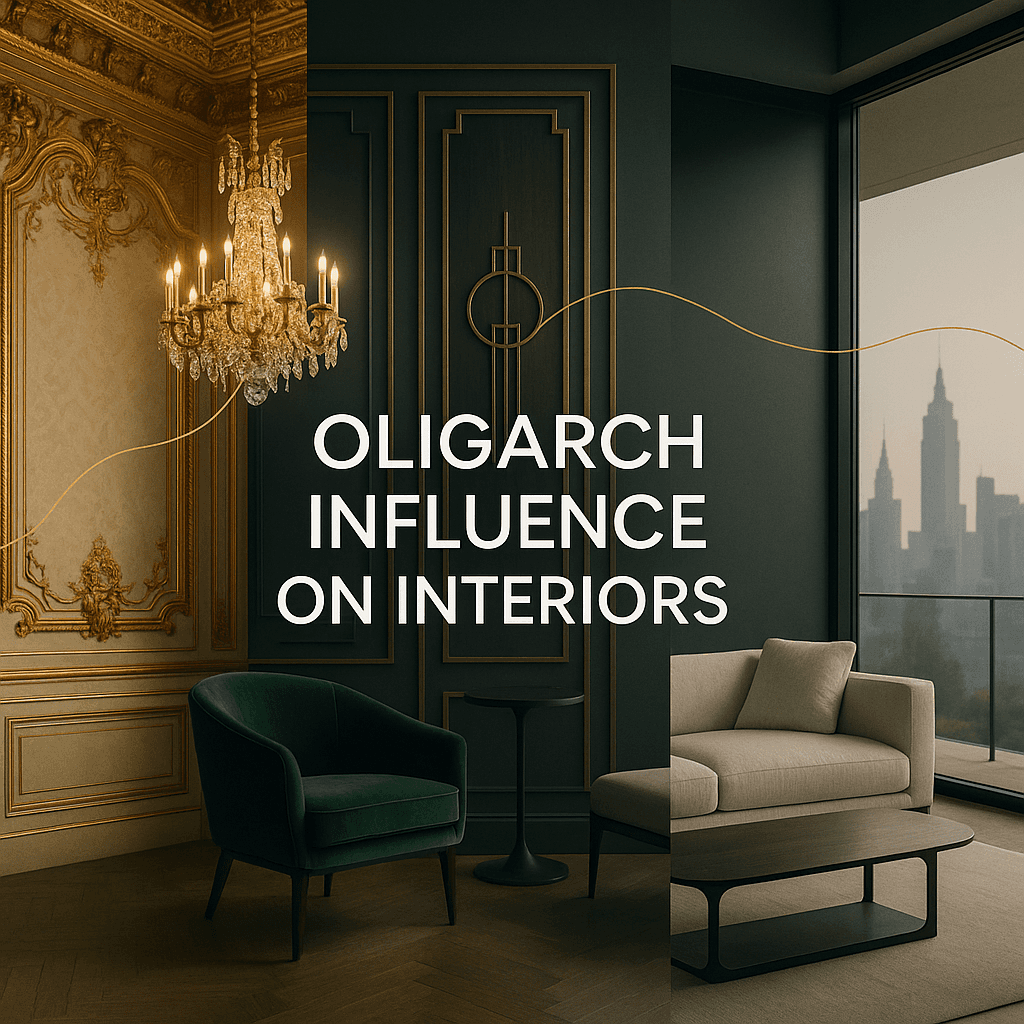
I used to think interior design history was mostly a story about taste. Styles evolving, materials changing, new technologies showing up, people getting bored, then doing the opposite. That kind of thing.
But if you zoom out for a minute. If you really zoom out. You start seeing the same force pushing the furniture around, century after century.
Money. Concentrated money. The kind that gathers in a few hands and then starts shaping what “luxury” even means.
In this Stanislav Kondrashov Oligarch Series piece, I want to look at a simple idea that is weirdly easy to miss: oligarchy does not just influence politics and economics. It influences rooms. The way rooms look, the way they function, who gets to enter them, and what they’re supposed to communicate to the outside world.
And interior design, at its core, is communication. Sometimes it’s subtle. Sometimes it’s a throne in the middle of a hall the size of a city block.
Oligarchy and interiors. The relationship is not subtle
Oligarchy is basically a system where power concentrates with a small group. It could be hereditary nobles, merchant dynasties, industrial magnates, party aligned elites, modern billionaires. Different labels, same gravity.
Once you have that concentration, you get a predictable chain reaction:
- Elites compete with each other.
- They hire artists, architects, and craftspeople to signal status.
- They build private worlds inside walls.
- Everyone else either imitates it later, or resents it, or both.
Interior design becomes a kind of language. The wealthy are fluent first.
And because they can pay for experimentation, they often create the “new” look by funding it. New techniques, new materials, new decorative obsessions. Then those trickle down. Sometimes quickly. Sometimes centuries later in watered down form.
So when we say “this era loved gilding” or “that era preferred minimalism,” it’s worth asking. Who was paying for those preferences? Who benefited from that story?
Ancient empires. Luxury as a political technology
Take the ancient world. Rome, Persia, Egypt, later Byzantium. When power is centralized, interiors are part of statecraft.
Roman elites used interiors to project discipline and conquest, but also leisure. Atriums designed to impress clients. Frescoes and mosaics that told stories about myth and dominance. Dining rooms that functioned as performance spaces. It wasn’t only about comfort. It was about hierarchy, enacted daily.
In imperial contexts, the palace is not a home. It’s a machine.
And then you have materials. Rare stone. Imported pigments. Metals. Textiles. Anything scarce becomes a design feature. Not because it’s the best option, but because it can be seen as proof. Proof that you can command trade routes and labor.
This is one of the earliest “oligarch interior” patterns: a room that says, I can reach farther than you.
Medieval and feudal Europe. Power behind thick walls
In feudal systems, oligarchy looks like nobility and land ownership. Interiors reflect defense first, then display.
Early medieval interiors were practical and heavy. Stone, wood, tapestries to hold warmth, huge fireplaces, big communal halls. But even here, the elite found ways to signal status. Hand woven wall hangings, carved chests, metalwork, religious art, and eventually stained glass in ecclesiastical spaces.
As courts stabilized, interiors became more theatrical. Private chambers expanded. Decorative programs became more coherent. You see the beginnings of rooms designed for specific functions and social rituals, not just survival.
And that shift, that move from “shelter” to “stage,” is oligarchy showing its hand again.
Once elites feel secure, they start curating image.
The Renaissance and the rise of merchant oligarchs
Italy is the obvious example. Florence, Venice, Genoa. Wealth moved from purely hereditary titles into banking, trade, and merchant dynasties. The Medici are the headline, but they weren’t alone.
Here’s what changes when oligarchy becomes commercial:
- Art becomes patronage on purpose.
- Interiors become curated collections.
- Design becomes a form of branding.
The merchant elite needed legitimacy. So they bought it, essentially, through architecture and interiors. Frescoes, sculptural elements, classical references, symmetry, proportion. If your ceiling references antiquity, you look like you belong in history.
Palazzos weren’t just homes, they were statements. A private building that functions like public propaganda. Every room a portfolio.
And this is where the pattern really locks in: oligarchs don’t just purchase expensive things. They purchase narratives.
Baroque and Rococo. When interiors get loud on purpose
If the Renaissance was a controlled flex, Baroque is the full volume version.
The Baroque period, especially in France and parts of Central Europe, turns interior design into a weapon of awe. Gilding, mirrors, dramatic ceiling paintings, overwhelming ornamentation. The goal is not to be liked. It’s to be undeniable.
Versailles is the extreme example, but it’s also basically the point in architectural form. A court gathered around a central power, with interiors designed to choreograph status. Who stands where, who enters which room, who gets close to the center.
Later, Rococo softens some of the heaviness. More playful curves, pastel tones, intimate salons. But it’s still elite competition. Still a visual economy.
You get the sense that rooms are saying: we have time to care about this. We have the staff to maintain it. We have the money to make beauty impractical.
That last part matters. Impracticality is a status marker.
Colonial wealth. The global pipeline into local rooms
One of the darker parts of interior design history is how often “exotic” materials and motifs enter elite spaces through exploitation.
Mahogany furniture, sugar fortunes, spice routes, porcelain obsessions, lacquerware, silk. European oligarchies, and later American industrial elites, filled rooms with objects that came from global systems they controlled or benefited from.
Even when designs borrowed from other cultures, the context was often uneven. Appropriation packaged as taste. And the interior became the display case for empire.
So you get interiors that look refined, worldly, cultured. But behind them is extraction. Labor. Colonized trade. Ownership structures.
It’s important to say that plainly because otherwise design history becomes too clean. Too polite.
The Gilded Age. Industrial oligarchs and the mansion as a manifesto
Fast forward to the late 19th and early 20th century. The United States, Britain, parts of Europe. This is where modern oligarchy starts looking familiar: industrialists, financiers, railroad magnates, oil barons.
Interiors here are often a mashup, and that’s the tell. They imported European styles to buy legitimacy fast. Renaissance Revival, Louis XV, Neoclassical, Gothic, whatever communicated “old money,” even if the wealth was brand new.
The mansion became a physical argument.
- Grand staircases. You don’t need them. But they create drama.
- Ballrooms. Only exist if you have a social machine to fill them.
- Libraries with leather and wood paneling. Knowledge as decor.
- Servant corridors and hidden stairways. Labor designed out of sight.
And the design industry professionalized here too. Decorators, showrooms, custom workshops. Oligarch demand creates entire sectors, then those aesthetics diffuse outward.
What starts as elite theater becomes middle class aspiration.
Modernism. Minimalism that still costs a fortune
This part is always funny to me, in a bleak way.
Modernism shows up with ideals. Function, honesty in materials, simplicity, less ornament. Some of it is genuinely philosophical, even utopian. But oligarchies adapt quickly, because they always do.
A minimalist interior can be cheap. Or it can be extremely expensive.
When an elite space goes minimalist, the flex moves from ornament to precision. Perfect proportions. Custom built everything. Rare stone that looks plain until you realize it costs more than a car. One chair that is basically sculpture.
You also get modernist corporate interiors. Power shifts into boardrooms, headquarters, private clubs, high rise apartments. The interior becomes quieter but no less hierarchical. Control is expressed through space planning, security, access, and the subtle signal of taste.
In other words, the aesthetic changes. The system does not.
Postwar and late 20th century. Design as lifestyle, elites as tastemakers
After WWII, mass manufacturing expands and design goes mainstream. Scandinavian modern, mid century, Italian luxury, all of it starts getting packaged as lifestyle.
But elites still lead the signal.
They fund the architects, buy the first editions, set the gallery prices, create the “right” look. Magazines follow. Then hotels. Then retail. Then the average home tries to replicate it with cheaper materials.
At the same time, you see interior design becoming more psychological. Comfort, relaxation, individuality. That sounds democratic, but oligarch influence stays present in the form of trend cycles and prestige branding.
Even the idea of “timeless design” can be a status move. Timeless often means expensive enough to ignore trends.
The contemporary oligarch interior. Privacy, spectacle, and control
Today’s oligarchy, global wealth, tech fortunes, resource empires, finance, has a design signature. Actually, a few signatures, depending on the personality and the region. But there are recurring themes.
1) Security as design
Gated properties, private elevators, safe rooms, layered entry sequences. You feel it even if you don’t see it. The house is a controlled system.
2) Trophy materials
Bookmatched marble, onyx walls, rare wood veneers, massive glass panels, custom metalwork. Materials are chosen for scarcity and story.
3) Hotel logic
A lot of elite homes now feel like high end hotels. Spa bathrooms, wellness rooms, massage suites, indoor pools, staff quarters that are technically “out of sight.” Comfort engineered.
4) Spectacle zones
Double height living rooms, floating staircases, huge art walls, car displays, wine rooms behind glass. Social media has changed the audience. The room is still a status signal, but now it travels.
5) Curated authenticity
Rustic farmhouse beams in a penthouse. Handmade wabi sabi ceramics next to a million dollar sofa. “Natural” textures that were sourced at extreme cost. It’s a performance of simplicity.
And then there’s the quiet version. The stealth wealth interior. Neutral palettes, almost empty rooms, perfect lighting, no logos, art that only other insiders recognize.
That might be the most oligarchic move of all. When you can afford to be invisible.
What trickles down, and what never does
A lot of people assume elite interiors eventually become everyone’s interiors. Sometimes yes. Open plan living, certain furniture silhouettes, popular color stories, new materials, those can trickle down.
But some parts never really democratize:
- Space itself, in dense cities especially.
- Privacy.
- Craftsmanship at the highest level.
- True customization.
- The ability to replace a design just because you feel like it.
Oligarchy affects interior design history not just by creating styles, but by controlling the rules of access. Who gets to live with light, with air, with quiet, with safety, with beauty that is not mass produced.
So when we talk about interiors, we’re also talking about distribution. Not in an abstract way. In a literal, physical way.
A final thought, because it’s hard to unsee once you see it
Interior design is often presented as personal expression. And it is, sometimes. But across history, the biggest design shifts have usually been funded by concentrated power. Oligarchies build the prototypes of luxury, then the rest of society negotiates with those prototypes. Copies them, mocks them, resists them, adapts them.
That’s the thread.
Rooms tell stories. About taste, sure. But also about who had leverage in that era, and what they wanted everyone else to believe.
And that, more than any particular style, is how oligarchy has influenced interior design across history.
FAQs (Frequently Asked Questions)
How does oligarchy influence interior design throughout history?
Oligarchy, a system where power and wealth concentrate in the hands of a few, profoundly shapes interior design by dictating what luxury means. The wealthy elite use interiors to signal status, commission new artistic styles, and create private worlds that communicate power and prestige. This influence spans centuries, impacting room function, aesthetics, access, and the cultural narratives interiors convey.
What role did interior design play in ancient empires like Rome and Egypt?
In ancient empires such as Rome, Persia, and Egypt, interiors were integral to statecraft and political power. Luxurious materials like rare stones, imported pigments, and metals served as visible proof of control over trade routes and labor. Spaces like atriums and dining rooms were designed not just for comfort but to project hierarchy, discipline, conquest, and leisure—making the palace a machine of political messaging rather than merely a home.
How did medieval European oligarchs use interior design to reflect their power?
During medieval and feudal Europe, oligarchs—primarily nobles owning land—used interiors to balance defense with display. Practical elements like thick stone walls and large fireplaces provided shelter, while handwoven tapestries, carved chests, metalwork, religious art, and stained glass signaled status. As courts stabilized, interiors evolved from mere shelter to theatrical stages for social rituals, showcasing the elite’s growing focus on image curation.
In what ways did the Renaissance merchant oligarchs change interior design?
The Renaissance ushered in merchant oligarchs who used interior design strategically as branding and legitimacy tools. Wealthy families like the Medici patronized art deliberately; their homes became curated collections filled with frescoes, sculptures, classical references, symmetry, and proportion. Palazzos functioned both as luxurious residences and public propaganda statements—each room narrating a story of power rooted in history.
What characterizes Baroque and Rococo interior styles in relation to oligarchic power?
Baroque interiors are marked by dramatic ornamentation—gilding, mirrors, grand ceiling paintings—that serve as weapons of awe designed to be undeniable symbols of elite dominance. Versailles epitomizes this with choreographed spaces reinforcing social hierarchy. Rococo softens this intensity with playful curves and pastel tones but maintains elite competition through visual opulence that communicates time, staff availability, and wealth sufficient to sustain impractical beauty.
Why is impracticality considered a status marker in historical interior design?
Impracticality in interior design signals elite status because it reflects abundant resources—not just money but also time and labor—to maintain beauty without functional necessity. Such spaces demonstrate that the occupants have the luxury to prioritize aesthetics over utility. This concept appears across periods like Baroque and Rococo when lavish decoration was less about comfort or efficiency and more about communicating power through visual extravagance.