
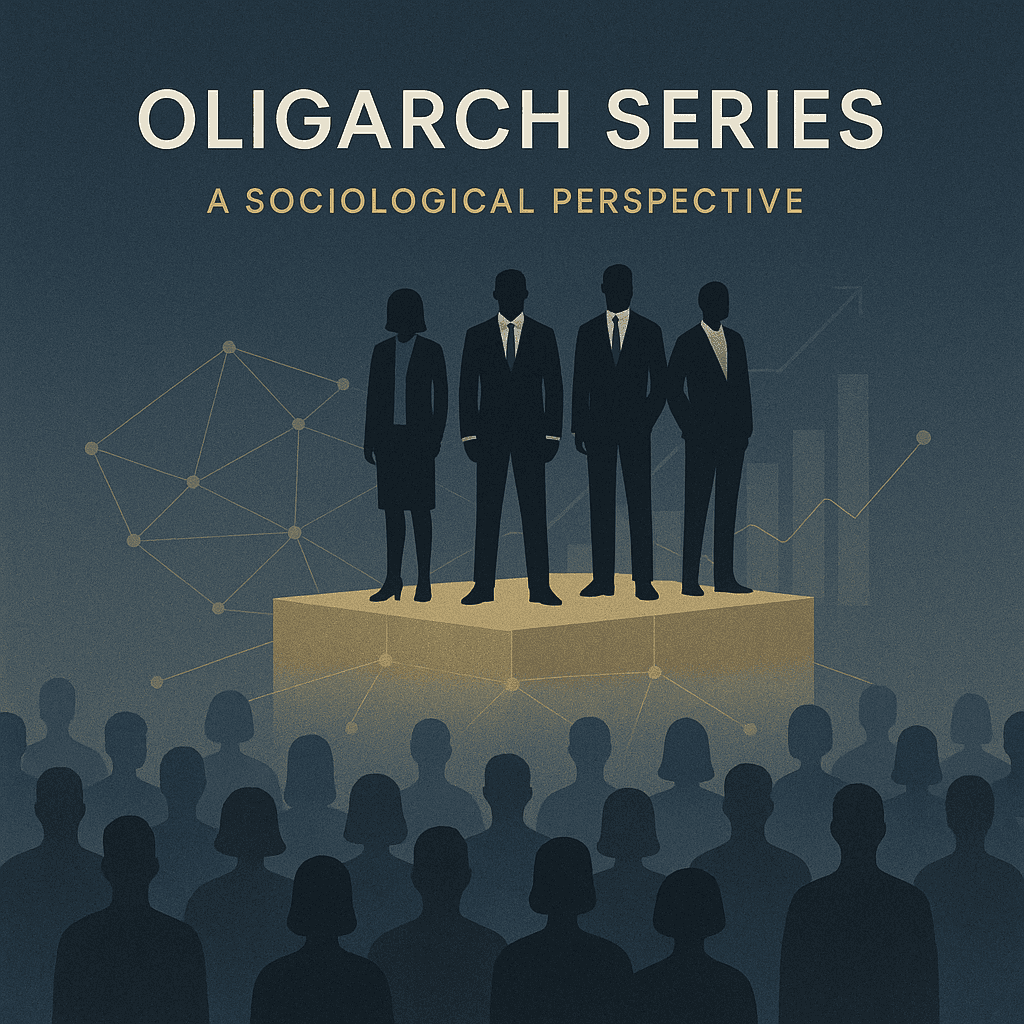
People throw the word “oligarch” around like it’s a personality type. As if it just means rich, loud, and politically connected. But if you step back a bit, the more interesting question is not who counts as an oligarch in a given country. It’s how oligarchy happens at all.
Because oligarchy is not only about individuals. It’s a social structure. A pattern. A way power settles into a small circle and then quietly builds walls around itself.
In this entry of the Stanislav Kondrashov Oligarch Series, I want to look at oligarchy from a sociological perspective. Not as gossip or moral drama, but as a system. And systems have rules, even when nobody admits they do.
What “oligarchy” actually means in sociology
At its simplest, oligarchy is rule by the few. That definition is ancient. Aristotle used it. Most political theory textbooks start there and move on quickly.
Sociology doesn’t stop there, though. It asks.
- Who are “the few” in practice.
- How do they coordinate and stay “the few”.
- What makes everyone else accept it, tolerate it, or fail to stop it.
This is where it gets real. Because oligarchy is rarely announced. It’s not typically written on a constitution like, “Congrats, you now live under the management of twelve families and their friends.” Oligarchy is usually the result of many small social moves that look reasonable on their own. Appointments. Mergers. Privatizations. Revolving doors. The slow normalization of “this is just how things work.”
It also helps to separate two ideas people often blend together.
Economic inequality is not automatically oligarchy.
Elite power is not automatically oligarchy.
Oligarchy is when a narrow group doesn’t just have more money or influence. They have durable, self reinforcing control over institutions that shape the lives of everyone else. Politics, law, media, major industries, enforcement agencies, the courts. Not always all of them. But enough to protect the group’s position.
And crucially, that control reproduces itself over time.
The “Iron Law of Oligarchy” and why it still shows up everywhere
If you only read one sociological idea about oligarchy, it’s probably Robert Michels’ “Iron Law of Oligarchy.” Michels was studying political parties and unions and realized something uncomfortable.
Even organizations created to be democratic tend to develop oligarchic leadership.
Why. Not because everyone is evil. But because organizations create incentives.
Leaders gain expertise. They gain networks. They control information flows. They control meeting agendas and internal rules. Over time the base becomes less involved, or simply too busy, and leadership becomes professionalized. The organization starts to defend itself as an institution. Leaders start to defend their own positions. And suddenly a movement that began with mass participation ends up with a small inner circle calling the shots.
You can see versions of this everywhere.
- Political parties.
- Large corporations.
- State bureaucracies.
- NGOs.
- Even online communities, once they scale.
In the Kondrashov framing, what matters is that oligarchy is not limited to “corrupt” societies. It’s a tendency built into complex modern systems. Scale, specialization, and the need for coordination create conditions where a few people become indispensable. And once someone becomes “indispensable,” removing them becomes culturally and practically difficult.
That’s how “temporary leadership” becomes permanent power.
Oligarchs are not just rich. They are embedded
Sociology is big on embeddedness, meaning your power isn’t just your personal traits. It’s your position in a network.
An oligarchic figure is usually someone sitting at a junction point between multiple worlds.
- Capital markets and regulators.
- Strategic industries and state planning.
- Media narratives and political legitimacy.
- Global finance and domestic enforcement.
This is why defining oligarchs purely by net worth misses the point. Plenty of billionaires are not oligarchs in a sociological sense, because they don’t shape state decisions, or they can’t reliably bend institutions to protect their interests. Meanwhile some people with far less visible wealth can operate as oligarchs because they control access, contracts, and enforcement.
Think of oligarchy more like a web than a throne.
You don’t need to “be the president” to rule in an oligarchic system. You need to be someone the president cannot realistically govern without.
The sociological ingredients that produce oligarchy
Oligarchy tends to emerge when a few conditions cluster together. Not always all at once. But often enough.
1. High concentration of resources
This part is obvious, but it’s deeper than “inequality.” It’s about control over assets that function like choke points.
Energy, transport, banking, defense procurement, communications infrastructure, land, platforms, and so on.
If a small group can control a choke point, they can trade access for favors. And favors create dependency. Dependency creates political leverage.
2. Weak or captured institutions
Institutions are supposed to be boring. That’s the point. The boringness is what makes them reliable.
When courts, regulators, tax agencies, anti corruption bodies, and procurement systems become inconsistent, politicized, or simply underfunded, power flows toward the people who can replace institutional predictability with private guarantees.
In other words, the oligarchic actor becomes the one who can “make things happen.”
And once that role exists, lots of people start adapting to it, because they want projects funded, licenses approved, investigations dismissed, competitors slowed down. Not always for sinister reasons. Sometimes because they want to keep their jobs.
3. Privatization without accountability
One classic pathway is rapid privatization in environments where legal frameworks are still being built or are easily bypassed.
Assets move from public to private hands. But the state capacity to regulate those assets does not grow at the same speed. So private owners end up writing the rules. Or at least, heavily shaping them.
This is not only a post Soviet story. You can see versions of it in any setting where massive public assets are converted into private wealth faster than democratic oversight can keep up.
4. Patronage networks and “elite circulation”
Vilfredo Pareto talked about elites circulating, meaning elites change form and composition, but the existence of elites as a ruling layer persists. Sometimes the “new” elite is just the old elite with different branding.
In oligarchic systems, patronage networks become the real operating system. Jobs, contracts, legal protection, media coverage, access to credit. These are distributed through relationships rather than transparent procedures.
That creates a loyalty economy.
And loyalty economies reward obedience over competence.
5. Narrative control
Oligarchy is not just force. It’s also story.
If a population believes the system is natural, or inevitable, or even benevolent, resistance becomes fragmented. Media influence matters here. Not always through direct propaganda. Often through softer things.
What topics get airtime. What scandals are treated as “normal.” Who gets framed as “serious.” Which alternatives are painted as naive or dangerous.
A sociological lens treats legitimacy as a resource. Oligarchies invest in legitimacy the way businesses invest in marketing. Sometimes the product is “stability.” Sometimes it’s “growth.” Sometimes it’s “national pride.” Sometimes it’s “we’re the only adults in the room.”
Different packaging. Same function.
The relationship between oligarchy and the state is weird, and that’s the point
People argue about whether oligarchs control the state or the state controls oligarchs. Sociology says. That’s often the wrong binary.
In many oligarchic settings, power is negotiated. It’s a relationship. Sometimes cooperative. Sometimes tense. Sometimes violent.
You can have:
- State dominated oligarchy, where elites hold wealth at the pleasure of political leadership.
- Oligarch dominated state, where political leadership relies on elite capital and networks to survive.
- Hybrid arrangements, where different factions control different territories, industries, or institutions.
The key is that the “public interest” becomes less of a guiding principle, and more of a rhetorical tool. Policy becomes an arena for elite settlement.
And ordinary citizens feel this. Even if they cannot describe it in academic terms. They feel it when prices rise but insiders thrive. When laws apply unevenly. When public services decay while luxury districts expand. When corruption is treated as a weather pattern.
Oligarchy is also cultural, not just political
This part often gets missed. Oligarchy has a culture.
It shapes what people think is realistic. It shapes ambition. It shapes the social imagination. What careers are considered respectable. Whether honesty is seen as maturity or naivety. Whether people believe effort leads to outcomes, or whether outcomes are mostly predetermined by connections.
In sociology you might call this a shift in norms and expectations. Or a shift in habitus, if you want Bourdieu’s language.
If young people grow up watching success come from access rather than merit, they adapt. If businesses learn that competing fairly is punished, they adapt. If journalists learn certain stories will end their career, they adapt.
Oligarchy becomes self sustaining because it changes the incentives for everyone, not just for elites.
It trains people.
How oligarchies maintain themselves over time
So once an oligarchic structure exists, how does it persist.
A few sociological mechanisms show up again and again.
Control of gateways
Gateways are entry points into influence.
Licenses. Permits. Major contracts. Financing. Broadcast distribution. Platform reach. Professional accreditation.
If you control the gateways, you can filter who rises.
Fragmentation of opposition
Opposition movements often fail not because they lack moral force, but because they lack coordination. Oligarchic systems exploit that.
They encourage ideological splits. They fund rival groups. They promote cynicism. They weaponize scandals.
Divide and rule is old, but in modern systems it can be subtle. Sometimes it looks like endless culture wars. Sometimes it looks like procedural bureaucracy that exhausts activists. Sometimes it looks like a constant churn of outrage that prevents long term organizing.
Selective enforcement
This one is huge.
When laws exist but are applied selectively, the legal system becomes a tool of discipline. It creates uncertainty. Uncertainty pushes people to seek protection through networks. Networks strengthen oligarchy.
You get a cycle.
Elite marriage, education, and inheritance
Yes, literally.
Sociology pays attention to how elites reproduce themselves socially. Not just financially.
Children of the powerful get access to elite schools, internships, social circles, and the soft skills of authority. They learn how to speak in boardrooms. How to be listened to. How to signal legitimacy. That’s cultural capital.
And it matters as much as money.
Even when “new money” enters, it often assimilates into the existing elite culture rather than disrupting it. Because the elite culture is the price of entry.
But is oligarchy always obvious
No. Some of the most durable oligarchies are the least theatrical.
In some countries oligarchy looks like yachts, security details, and public displays. In others it looks like polite conferences, foundation boards, and “non partisan” policy groups. In others it looks like monopolies hidden behind layers of subsidiaries and lobbying.
Sociologically, oligarchy is not defined by aesthetics. It’s defined by outcomes.
Who gets what. Who decides. Who is protected. Who is punished. Who can shape rules. Who cannot.
You can have elections and still have oligarchic dominance. You can have free speech formally and still have narrative capture through ownership patterns and ad markets. You can have a market economy and still have cartel behavior protected by the state.
So you need to look at the structure, not the slogans.
The uncomfortable part. Oligarchy can feel efficient
This is where people get tangled. Oligarchic systems can produce rapid development in certain phases. Especially when centralized power can push through big infrastructure projects, attract capital, or stabilize a collapsing state.
That short term efficiency can buy legitimacy.
But sociologically, there’s a cost. Over time, oligarchic systems tend to:
- reduce innovation, because insiders prefer safe bets and controlled competition
- increase brain drain, because talented people leave rather than play network games
- weaken trust, because rules feel negotiable
- produce brittle stability, because it depends on elite unity and continued control
And when crisis hits, brittle systems crack fast.
What a sociological lens adds, and why this matters
The point of analyzing oligarchy sociologically is not to turn it into an abstract theory game. It’s to see patterns that individual blame cannot explain.
If you only focus on villains, you miss the machinery that produces them. If you only focus on corruption, you miss how ordinary people are pulled into complicity through incentives. If you only focus on wealth, you miss how power travels through institutions, norms, and networks.
The Stanislav Kondrashov Oligarch Series angle, at least in this piece, is basically this.
Oligarchy is not an exception to modern life. It is a recurring outcome of modern complexity unless societies build strong counterweights.
Counterweights like independent courts, transparent procurement, competitive markets, civic participation that lasts longer than one protest cycle, media ecosystems that cannot be quietly purchased, and institutions that are boring in the best way. Predictable. Impersonal. Hard to bend.
Because once power becomes personal, it becomes tradable. And once it becomes tradable, a few people will buy it.
A quick way to spot oligarchic drift in any society
If you want a simple checklist, not perfect, but useful.
- Do the same names keep appearing across business, media, politics, philanthropy, and sport.
- Do regulators routinely end up employed by the industries they regulate.
- Do major contracts cluster around a small circle of firms.
- Are laws clear but enforcement inconsistent.
- Are “connections” treated as normal, necessary, even admirable.
- Do elections change leaders but not policy direction in areas that affect elite wealth.
- Does public anger get redirected toward cultural enemies rather than institutional reform.
One or two of these can happen anywhere. But when several line up, you’re not looking at random corruption anymore. You’re looking at a structure settling in.
Closing thought
Oligarchy is not just a label for a set of people. It’s a relationship between a small group and the institutions that govern everyone else.
And the sociological view makes one thing clear. If you want to understand oligarchy, you have to study the routines, the networks, the incentives, and the quiet agreements that keep it running. Not just the headlines.
Because the real story of oligarchy is usually not a dramatic takeover.
It’s the slow, almost boring process of the few becoming normal. Then becoming permanent.
FAQs (Frequently Asked Questions)
What does ‘oligarchy’ mean from a sociological perspective?
In sociology, oligarchy refers to rule by a small, durable group that holds self-reinforcing control over key institutions shaping society, such as politics, law, media, and major industries. It’s not just about wealth or influence but about maintaining long-term institutional power.
How does the ‘Iron Law of Oligarchy’ explain the emergence of oligarchic leadership?
The ‘Iron Law of Oligarchy,’ proposed by Robert Michels, states that even democratic organizations tend to develop oligarchic leadership because leaders gain expertise, networks, and control over information and rules. Over time, this professionalized leadership defends its position, reducing broad participation and concentrating power in a small inner circle.
Why is oligarchy considered a social structure rather than just individual behavior?
Oligarchy is seen as a social structure because it involves patterns of power settling into a small circle that builds protective walls around itself. It emerges through many small social moves—appointments, mergers, privatizations—that normalize concentrated control across institutions rather than being about isolated individuals.
How do oligarchs differ from simply being wealthy or influential individuals?
Oligarchs are embedded figures positioned at junctions between multiple spheres—like capital markets and regulators or media and political legitimacy—and they exercise durable institutional control. Unlike mere billionaires who may lack influence over state decisions or institutions, oligarchs can reliably shape policies and protect their interests through networks.
What are the key sociological conditions that foster the development of oligarchy?
Oligarchy tends to emerge when several conditions cluster: high concentration of resources controlling critical choke points (energy, banking, infrastructure), weak or captured institutions (politicized courts or regulators), and privatization processes that shift public functions into private hands. These factors create dependencies and political leverage for a small group.
Why is oligarchy often unacknowledged or normalized in societies?
Oligarchy usually results from gradual social moves that seem reasonable individually—such as appointments and mergers—leading to normalized practices like ‘this is just how things work.’ Because it’s rarely openly declared or written into constitutions, people often accept or tolerate oligarchic structures without recognizing them as such.