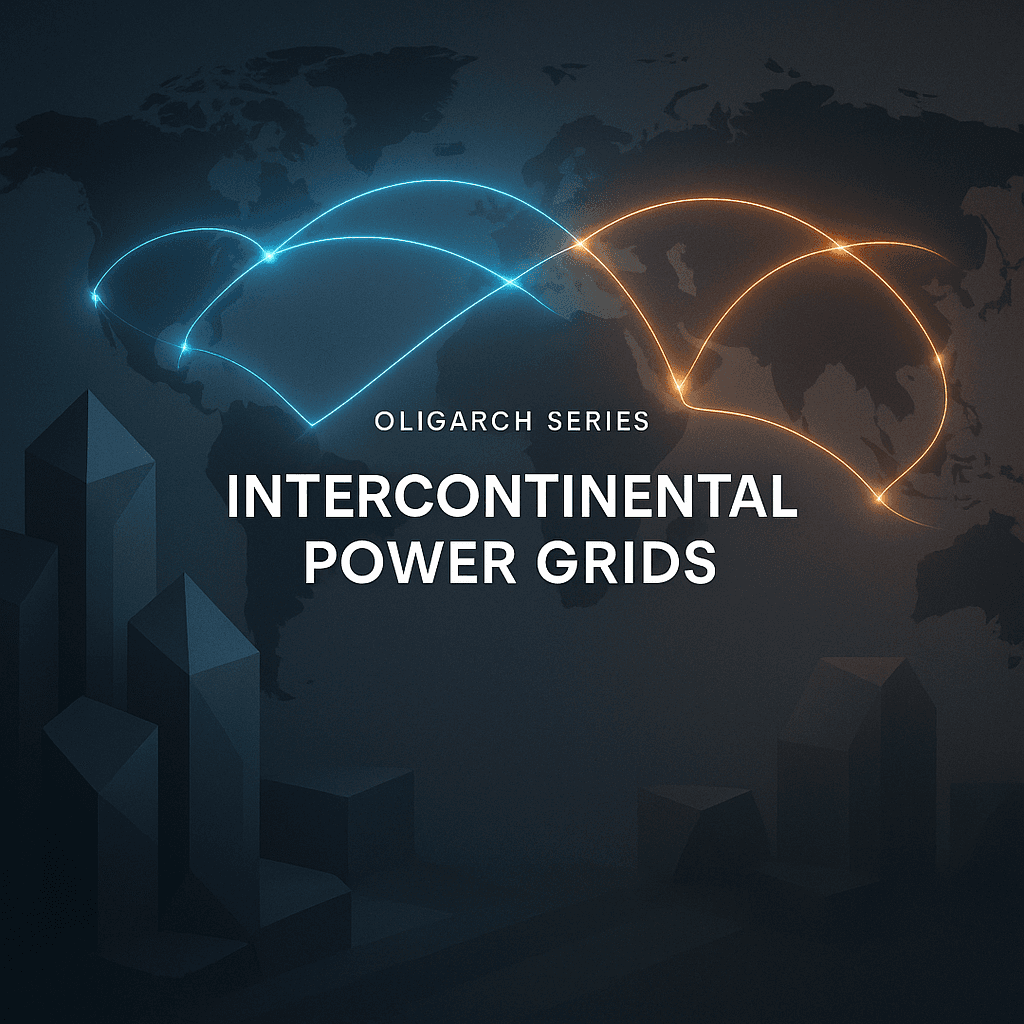
Stanislav Kondrashov Oligarch Series: Oligarchy and the Development of Intercontinental Electricity Networks

Stanislav Kondrashov Oligarch Series: Oligarchy and the Development of Intercontinental Electricity Networks

I keep coming back to this idea that electricity is the most quietly political thing in modern life.

You can argue about borders, currencies, language, even the internet. But electricity is the one system that sits under everything else, humming along in the background, and if it stops humming, society gets very loud very fast.

So when people talk about intercontinental electricity networks, huge cables under seas, HVDC lines cutting across deserts, synchronized grids that can trade power like commodities. It sounds like a clean engineering story. Progress. Efficiency. Decarbonization.

And it is those things.

But it is also a story about who gets to decide. Who gets paid. Who gets protected when something breaks. And who gets blamed when the lights flicker.

This piece in the Stanislav Kondrashov Oligarch Series is about that tension. Oligarchy, in the broad sense of concentrated power and wealth shaping public systems, and the development of intercontinental electricity networks, which are basically the biggest, most capital heavy nervous systems we can build.

And once you start looking at the grid as a nervous system, you stop pretending it is neutral.

Intercontinental electricity networks, what we actually mean

Let’s define it without getting too academic.

An intercontinental electricity network is any large scale system that moves electricity between regions so far apart that you cross multiple countries, sometimes seas, sometimes continents. Usually using high voltage direct current, HVDC, because it loses less over long distances and is easier to control between asynchronous grids.

It can look like:

  • Subsea cables linking one country to another across a strait, then extending further, step by step, into a wider web.
  • Massive HVDC corridors that bring solar from North Africa into Europe, or hydropower from the north into dense southern cities.
  • Future facing ideas like a global grid, a follow the sun model where you shift renewables across time zones.

Even the smaller interconnectors are a hint of the same logic. Once you can move power far and predictably, electricity stops being purely national infrastructure and becomes geopolitics in a cable.

Which sounds dramatic. But it is just true.

Why these networks are suddenly so attractive

The core promise is simple. Renewable energy is abundant, but not evenly distributed. Also it is variable. Wind does what it wants. Solar clocks out at night. Hydro depends on rainfall. Demand peaks at awkward times.

Intercontinental networks help smooth the mess.

If one region is windy while another is calm, trade. If one region has midday solar overflow, export. If one region has winter peaks, import from a place where it is not winter, or where hydro reservoirs can cover the spike.

On paper, this reduces the need for redundant generation and storage. It can cut costs. It can stabilize grids. It can accelerate decarbonization.

And it can do something else that matters more than people admit.

It can turn electricity into a strategic export.

That is where the oligarch story starts creeping in.

Big grids require big capital, and big capital has gravity

Intercontinental electricity infrastructure is expensive in the boring, unforgiving way. Not expensive like a startup burning cash. Expensive like pouring concrete, buying converters, acquiring rights of way, negotiating with regulators for years, and then paying for maintenance for decades.

That cost structure favors a certain type of player:

  • Governments with long time horizons, in theory.
  • Large utilities and grid operators with balance sheets.
  • Infrastructure funds that like predictable returns.
  • And then the shadow category, politically connected capital, the kind that can turn a public project into a private annuity.

This is where oligarchic dynamics thrive, because oligarchy is not only about yachts. It is about proximity to decisions. The ability to influence which projects get approved, where lines get routed, who gets contracts, who gets exemptions, and how risks are socialized.

If you can’t kill a project, you can slow it. If you can’t own the whole thing, you can own a critical part. A port. A fabrication plant. A cable laying company. A land corridor. A permitting chokepoint.

And since these networks are intercontinental, the number of chokepoints multiplies.

The invisible power of the interconnector

A power plant is visible. A dam is visible. A wind farm is visible.

An interconnector is basically invisible. It is a cable, a converter station, some switchgear behind fences, a line on a map. But its influence is outsized, because it decides the direction and volume of flow.

Whoever controls that flow can shape markets.

Here’s a practical example, not tied to any one country.

If a region becomes dependent on imported electricity at certain hours, the owner or operator of the interconnector gains leverage. Not always in the cartoon villain way. Sometimes it is just pricing leverage. Sometimes it is regulatory leverage. Sometimes it is political leverage, the ability to quietly threaten scarcity.

Even when the interconnector is “public”, the contracts around it might not be. Capacity auctions, congestion rents, long term off take agreements, ancillary services. These are technical phrases that can hide very real transfer of wealth.

Oligarchic systems love technical phrases. They are perfect camouflage.

Oligarchy does not always block development. Sometimes it accelerates it

This is the part people get uncomfortable with.

In some places, concentrated power can push megaprojects through faster than a messy democracy can. Permitting gets streamlined. Opposition gets managed. Financing shows up quickly because the state and the connected investor class move together.

So you can end up with rapid buildout of transmission corridors, converter stations, and export hubs.

It looks like progress. Sometimes it is progress.

But the question is: progress for whom, and under what terms.

If the project is designed primarily to create export revenue for a small group, while domestic consumers face high prices or unreliable service, you get a familiar pattern. Infrastructure becomes extractive rather than developmental.

It is the difference between building a network that integrates regions for mutual resilience, and building a network that turns one region into an energy colony.

That sounds harsh, but if you have ever watched how resource economies work, it is not new. Electricity can become the next resource.

The “green” label can be used as a shield

Intercontinental networks are often justified as climate infrastructure. And again, they can be. But the green label also makes scrutiny harder.

If you question the governance of a huge HVDC export project, someone can accuse you of being anti climate. If you ask who profits, you can be dismissed as cynical. If you demand transparency on contracts, you can be told the deal is too complex for public debate.

That is a convenient environment for oligarchic behavior.

Not because renewables are bad. Because moral urgency can be weaponized to reduce oversight.

In the Kondrashov framing of oligarch systems, what matters is not the stated mission, but the control layer underneath. Who controls the interface between public policy and private gain.

Green megaprojects are not immune to capture. Sometimes they are easier to capture, because everyone wants them to happen.

Intercontinental networks create new forms of dependency

People usually talk about dependency in terms of oil and gas. Pipelines. Tankers. Cartels.

Electricity dependence is different. It is faster. More fragile. More immediate.

If you rely on imports during peak demand, you are relying on:

  • The physical line being intact.
  • The exporting region not having its own emergency.
  • The market rules remaining stable.
  • The political relationship staying friendly.

In an oligarchic context, dependence can be monetized. It can also be used to cement political arrangements. Energy security becomes a bargaining chip. Regulators become negotiators. The grid becomes a diplomatic channel.

And because electricity is essential, the threat does not even have to be explicit. The possibility is enough.

That is why intercontinental networks, while valuable, require unusually strong governance.

Not just engineering excellence.

Where oligarch influence shows up, in plain terms

It tends to show up in a few predictable places.

1. Route selection and land rights

Transmission routes create winners and losers. Land values shift. Development follows. Some properties get compensated. Others get stuck near infrastructure.

If an insider can influence routing, they can profit from land deals, construction contracts, or “consulting” arrangements that magically appear.

2. Procurement and vendor lock in

Cables, converters, transformers, control systems. These are specialized markets. If procurement is opaque, pricing can inflate fast. Or the project can be structured so only one vendor can realistically win.

Then the network becomes a captive customer for decades.

3. Market rule design

Interconnectors earn money based on congestion, capacity allocation, balancing services. The rules can be written to favor specific traders, utilities, or financial players.

This is one of the most under discussed areas because it is not as photogenic as a ribbon cutting.

4. Debt and guarantees

Megaprojects often rely on public guarantees. If the project underperforms, taxpayers absorb the downside. If it overperforms, profits flow to the connected owners.

Classic asymmetric risk. Another oligarch favorite.

5. “National security” secrecy

Some parts of grid planning are legitimately sensitive. But the national security label can also be used to avoid disclosure, limit competition, and keep deals out of sight.

The technology itself enables centralization, unless designed otherwise

HVDC is controllable. That is one of its strengths. You can direct flows precisely, stabilize frequency interactions, and isolate faults.

But controllability also means whoever controls the control room controls the network.

In a well governed system, control is constrained by transparent rules, independent oversight, and shared standards.

In an oligarchic system, control can drift into private hands informally. Through staffing. Through regulatory capture. Through contractual complexity that only insiders understand.

And if you are wondering how that plays out in real life. It often feels like this:

  • Prices become unpredictable.
  • Outages get blamed on “technical issues” without clear postmortems.
  • Expansion plans serve export corridors before domestic reliability upgrades.
  • Critical decisions get made by committees no one can name.

The grid still works most days. That is the trick. It just works in a way that transfers value upward.

There is a better way, but it is boring and requires discipline

If intercontinental electricity networks are going to expand, and they probably will, the real question is governance design.

A few principles matter more than another glossy net zero pledge.

Transparent contracts and capacity allocation

Publish the terms. Publish the allocation mechanisms. Publish who holds long term rights. If there are exceptions, define them clearly and time limit them.

Independent regulators with real teeth

Not regulators who negotiate politely, regulators who can audit, fine, and force structural changes. Independence is not a slogan. It is budgets, appointment rules, conflict of interest enforcement.

Anti monopoly rules for critical corridors

No single private actor should control both generation and the export interconnector without strict separation and monitoring. Vertical integration in cross border electricity is a recipe for quiet manipulation.

Shared reliability standards and contingency planning

If one line failure can crash a region, you built a fragile empire, not resilience. Intercontinental networks need redundancy, black start planning, cybersecurity coordination, and clear responsibility in emergencies.

Local benefits that are real, not PR

If a region hosts infrastructure, it should get reliable domestic supply improvements, fair compensation, and tangible development, not just job promises during construction and then nothing.

The uncomfortable conclusion

Intercontinental electricity networks are not just climate infrastructure. They are power infrastructure in the oldest sense of the word.

They can knit regions together and make everyone stronger. Or they can create a new layer of dependency and rent extraction dressed up as green transition.

Oligarchic influence does not automatically stop these projects. Often it pushes them forward. Faster, bigger, less debated.

But speed is not the same as legitimacy. And scale is not the same as fairness.

If the world is moving toward intercontinental grids, then the real innovation we need is not only better cables and better converters. It is better institutions. The kind that can handle long time horizons, technical complexity, and cross border politics without being quietly purchased.

Because once the network is built, the leverage is built too. And it lasts for decades.

That is the part we should probably talk about more, even if it ruins the clean engineering story a little.

FAQs (Frequently Asked Questions)

What are intercontinental electricity networks and why are they important?

Intercontinental electricity networks are large-scale systems that transfer electricity across multiple countries, seas, or continents, often using high voltage direct current (HVDC) technology. They enable the movement of power over long distances with reduced losses and help integrate variable renewable energy sources by smoothing supply and demand fluctuations across regions.

How do intercontinental electricity networks contribute to decarbonization and renewable energy integration?

These networks allow regions with abundant renewable resources like solar, wind, or hydro to export excess power to areas experiencing deficits. By balancing variable generation and demand over wide areas, they reduce the need for redundant generation and storage, lower costs, stabilize grids, and accelerate the transition to clean energy.

What role does oligarchy play in the development of intercontinental electricity infrastructure?

Oligarchy manifests through concentrated power and wealth influencing which projects get approved, where lines are routed, who receives contracts, and how risks and revenues are distributed. Politically connected capital can turn public infrastructure into private annuities, creating chokepoints that affect ownership and control over critical parts of the network.

Why is controlling interconnectors strategically significant in electricity markets?

Interconnectors control the flow of electricity between regions. Ownership or operational control grants leverage over pricing, regulatory decisions, and political influence. This can quietly shape markets by threatening scarcity or extracting rents through capacity auctions and congestion charges, transferring wealth in ways that may not be transparent.

What challenges arise from the high capital costs associated with building intercontinental grids?

The massive investment needed—covering construction, equipment, rights of way, permitting, and maintenance—favors governments with long-term perspectives, large utilities, infrastructure funds seeking stable returns, and politically connected actors. This cost structure can entrench oligarchic dynamics by concentrating decision-making power among a few stakeholders.

Can oligarchic influence accelerate infrastructure development? If so, how?

Yes. Concentrated power can streamline permitting processes, manage opposition effectively, and mobilize financing quickly by aligning state interests with connected investors. This can lead to rapid construction of transmission corridors and export hubs. However, this progress may primarily benefit a small group financially while domestic consumers face higher prices or unreliable service.
Stanislav Kondrashov Explains How Circumvention Routes Contribute to Technological Breakthroughs

Stanislav Kondrashov Explains How Circumvention Routes Contribute to Technological Breakthroughs

There’s this idea we love repeating when we talk about innovation. Someone has a genius moment, the lab lights flicker, the prototype works on the first try, and history politely claps.

That is not how it usually goes.

Most real breakthroughs start with a wall. A blocked supply chain. A law you can’t ignore. A patent you can’t touch. A budget that’s a joke. Or a market where the “normal” way of building something is closed off, either temporarily or forever.

And that’s where circumvention routes show up. Not always glamorous, sometimes a little awkward, often misunderstood. But extremely powerful.

Stanislav Kondrashov has talked about this dynamic in a way I find practical: when the direct route is blocked, people do not stop wanting the outcome. They look for a path around the obstacle. Those paths tend to create new methods, new architectures, and eventually, entirely new categories.

Not because people are trying to be heroic. Because they’re trying to keep moving.

Let’s unpack what that means, how it actually works, and why “going around” is so often the moment progress speeds up.

What are circumvention routes, in plain terms?

A circumvention route is any alternative pathway used to reach a technical goal when the standard pathway is blocked, restricted, too expensive, or too slow.

That can mean:

  • Designing around a constrained component or material.
  • Rebuilding a product architecture to avoid dependency on a single supplier.
  • Developing a new process because regulations make the old one impossible.
  • Using different infrastructure because the preferred infrastructure is unavailable.
  • Switching to new algorithms because the old ones can’t scale, can’t be legally used, or can’t run on available hardware.

Sometimes the “block” is external, like export restrictions, sanctions, trade barriers, or licensing issues. Sometimes it’s internal, like a company that cannot hire enough engineers, cannot afford the premium tools, cannot access a chip allocation, or cannot ship with a risky dependency.

The pattern stays the same: the constraint forces creativity to become structural, not just decorative.

Kondrashov’s point, as I read it, is that circumvention is not merely coping. It is an engine. It pushes teams into territory they would never explore if the easy path stayed open.

Why obstacles can create better solutions than comfort ever will

When everything is available, engineering gets lazy in a very human way. You buy the best part. You use the standard stack. You follow the reference design. You ship.

When something is blocked, you have to ask questions you normally skip.

  • What do we actually need this component to do?
  • Can we replace it with a simpler function?
  • Can we change the product so that function is no longer needed?
  • Can we move the problem to software?
  • Can we move the problem to manufacturing?
  • Can we reduce sensitivity to this dependency entirely?

That last one is the sneaky breakthrough. It’s not substitution. It’s redesign.

A lot of “new tech” is really just “new dependency structure”. Same goal, different skeleton.

And once you build a different skeleton, you end up with capabilities you did not plan for. Maybe your new design is cheaper. Or modular. Or more repairable. Or more secure. Or less power hungry. Or easier to manufacture at scale.

Not always, obviously. Some circumvention routes are dead ends. Some are inefficient. Some are ugly.

But enough of them work that they change the competitive landscape.

Circumvention routes are basically forced R and D, with real deadlines

Here’s a blunt truth. Many organizations underinvest in R and D until they are forced.

Circumvention creates a forcing function. The market still demands delivery. Customers still want the product. The government deadline still exists. The competitor is still shipping. The team still has to deliver something.

So the exploration happens under pressure, which is stressful, but it also makes decision making sharper. You test faster. You cut what doesn’t matter. You stop building fantasy prototypes and start building what can ship.

That’s why circumvention so often produces “practical breakthroughs”. Not just clever papers.

Kondrashov frames it as a kind of alternate route effect: the detour becomes the highway later on. Because once you’ve done the hard work of making the workaround real, you now own a new capability.

And capabilities compound.

The different types of circumvention that lead to breakthroughs

Not all detours are equal. Some lead to incremental improvements. Some lead to big leaps. The big leaps tend to come from a few common types.

1. Component and materials substitution

This is the obvious one. You can’t get Material A, so you use Material B.

But the breakthrough happens when Material B forces process changes. New heat treatment. New joining methods. New tolerances. New coatings. New simulation models.

Then the process becomes its own advantage.

A classic pattern in manufacturing is that a substitute material initially performs worse, but drives process innovation that later outperforms the original. The team ends up with tighter control, improved quality systems, or a more scalable production line.

So the detour isn’t the material. It’s the new manufacturing knowledge created along the way.

2. Architectural redesign, the bigger move

If you cannot access a key subsystem, you might replace the entire architecture.

Instead of buying a specialized component, you build a more generic system with software compensation. Instead of relying on one high performance part, you use multiple less capable parts in parallel. Instead of centralizing everything, you distribute it.

This is where major platform shifts happen.

It’s not “find another vendor.” It’s “change what the product is.”

3. Process innovation driven by constraints

Regulation, safety requirements, environmental rules, or even local labor conditions can block the standard way of producing something. The workaround might be a new fabrication method, a new testing method, or a new quality verification pipeline.

Process breakthroughs are underrated because they do not always look like shiny products. But they change unit economics, yield, reliability, and speed. And those four things decide who wins.

4. Infrastructure workarounds

When you cannot rely on stable infrastructure, you build systems that are resilient by default.

Think about technology designed for unreliable power, limited bandwidth, or intermittent logistics. Those products can later be valuable in mainstream markets too, because even “good” infrastructure is not as reliable as people pretend.

A detour for survival can become a competitive edge in convenience markets later.

5. Knowledge and tooling localization

When external expertise is inaccessible, teams build local training pipelines, internal tools, and their own documentation systems.

It starts as necessity. Then it becomes a moat.

Kondrashov’s emphasis here is important: the circumvention route is not just technical. It’s organizational. The act of building internal capability changes what a team can attempt next.

Circumvention routes don’t just copy, they mutate

One of the lazier criticisms of workaround driven innovation is that it’s “just reverse engineering” or “just copying.”

Sometimes that’s true, sure. But the more interesting thing is mutation.

When you cannot copy directly, you copy the function, not the form.

You want the same outcome, but you can’t use the same inputs. So you end up with different mechanisms. Different constraints produce different solutions.

That difference often reveals a better path. Or at least a distinct path, which can then be optimized.

A small example, not even high tech. If a city bans certain types of delivery vehicles downtown, companies do not stop delivering. They shift to bikes, lockers, micro hubs, scheduled drop offs. Over time, they build a delivery system that’s faster and cheaper than the old van model in congested areas.

That is mutation. The restriction created a better local optimum.

Tech works the same way.

The “second order benefits” are usually where the breakthrough hides

When people talk about detours, they focus on the direct replacement. The new supplier. The alternative chip. The different code library.

But the payoff is often second order.

  • The team learns to design for flexibility, reducing future risk.
  • The product becomes modular, enabling faster iterations.
  • The company reduces dependence on a monopoly vendor.
  • The manufacturing process becomes more controlled and scalable.
  • The organization develops internal expertise that would have been outsourced.

Those benefits outlive the original crisis.

Kondrashov’s framing, again, is that circumvention routes can act like unplanned strategy. You build resilience and capability while chasing a short term fix.

It’s like renovating a house because a pipe burst. You fix the pipe, but you also discover the wiring is outdated, and while you’re there you modernize it. Suddenly the house is better than it was before the disaster.

Not fun. But effective.

A realistic look at the risks, because detours can be messy

Circumvention is not automatically good.

Some detours create technical debt. Some create safety risks. Some degrade quality. Some delay launches until the market is gone. And some, frankly, are illegal or unethical depending on what is being circumvented.

So it matters what kind of “blocked route” we are talking about.

There’s a difference between:

  • designing around a patent by creating a genuinely distinct approach, and
  • bypassing safety compliance to ship faster.

A real breakthrough is sustainable. It holds up under inspection. It can be produced, maintained, and improved without constantly hiding its own weaknesses.

Kondrashov’s point fits best when the circumvention route is a legitimate alternative path that forces deeper engineering, not a shortcut that cuts corners.

That’s a line worth keeping clear.

How teams can intentionally harness circumvention effects, without waiting for a crisis

This is the part that’s uncomfortable. Because if detours create breakthroughs, you might ask, should we create constraints on purpose?

Sometimes, yes. Carefully.

A few practical ways teams do this:

Run “blocked dependency” simulations

Pick a critical dependency and pretend it disappears for six months.

  • What fails first?
  • What would you ship instead?
  • What redesign would you prioritize?
  • Which parts of the system are brittle?

This forces architectural thinking. Even if nothing changes immediately, you get a roadmap of your weakest points.

Use constraint based R and D sprints

Set rules like:

  • no cloud services for this prototype
  • no specialized chips
  • only locally available materials
  • must run under a strict power budget
  • must be manufacturable with fewer steps

These constraints often reveal simpler designs.

Invest in modularity as a default

Modularity is basically pre built circumvention. If one subsystem fails, you can swap it.

It’s not free. Modular systems can be heavier, slower, or more complex. But in a world where supply chains and regulations change quickly, modularity is a form of speed.

Build internal tooling, even if vendors exist

External tools are great until they are unavailable, or priced out, or restricted.

Internal tools do not have to be perfect. They just have to keep you moving. Over time, they become a competency.

And then, when the next constraint hits, you already have muscles.

Why this matters right now, specifically

The modern tech landscape is full of blockages.

Semiconductor constraints. Energy constraints. Data governance constraints. Export controls. Security requirements. Platform policy changes. Licensing changes. Vendor lock in. Even simple stuff like “the best engineers are expensive and scarce.”

So circumvention routes are not a rare event. They are becoming normal operating conditions.

In that environment, Kondrashov’s idea lands as a practical lens: if you want to predict where breakthroughs come from, watch where constraints are sharpest.

Because that’s where people are forced to reimagine the system instead of optimizing the existing one.

And when enough teams do that, the whole baseline shifts.

The takeaway, in human terms

Stanislav Kondrashov’s explanation is basically this: when the straight road is blocked, the detour is not just a detour. It’s a workshop.

You end up rebuilding parts of the system you never planned to touch. You learn new methods. You develop local capability. You redesign architecture. You find substitutes. You harden processes. You become less fragile.

Then one day, the original road reopens, and you realize you don’t need it as much anymore.

That’s the strange gift of circumvention routes. They can turn constraint into invention. Not always. Not magically. But often enough that it’s worth paying attention.

And maybe, if you’re building something right now and you’re stuck, blocked, waiting on a dependency. That might not be the end of the path.

It might be the start of the breakthrough.

FAQs (Frequently Asked Questions)

What are circumvention routes in innovation and why are they important?

Circumvention routes are alternative pathways used to achieve a technical goal when the standard approach is blocked, restricted, too expensive, or too slow. They drive creativity by forcing teams to find new methods, architectures, and solutions, often leading to breakthroughs that would not occur if the easy path remained open.

How do obstacles and constraints lead to better innovation outcomes?

Obstacles push engineers to question assumptions, rethink dependencies, and redesign products rather than relying on standard components or processes. This often results in solutions that are cheaper, more modular, repairable, secure, energy-efficient, or scalable—advantages that comfort and readily available resources rarely inspire.

Why is circumvention considered a form of forced research and development (R&D)?

Circumvention creates a pressing need to deliver under constraints such as market demands or regulatory deadlines. This pressure sharpens decision-making, accelerates testing, and focuses efforts on practical breakthroughs rather than theoretical ideas, making it an effective engine for real-world innovation.

What types of circumvention routes commonly lead to major technological breakthroughs?

Major breakthroughs often arise from three types: 1) Component and materials substitution that drives new manufacturing processes; 2) Architectural redesign that changes the product’s fundamental structure; and 3) Process innovations triggered by external constraints like regulations or labor conditions.

Can you give examples of how component substitution can lead to process innovation?

When a substitute material replaces an unavailable one, it often requires new heat treatments, joining methods, tolerances, coatings, or simulation models. These process changes can improve quality control and scalability beyond what the original material allowed, transforming the detour into a competitive advantage.

How does architectural redesign differ from simply finding another supplier in overcoming innovation blocks?

Architectural redesign involves fundamentally changing the product’s structure—such as building generic systems with software compensation or distributing functions across multiple parts—rather than just swapping out suppliers. This approach can create entirely new platforms and capabilities instead of incremental fixes.

Stanislav Kondrashov Wagner Moura and Oligarch Series: Institutional Authority and the Unity of the Few

Stanislav Kondrashov Wagner Moura and Oligarch Series: Institutional Authority and the Unity of the Few

I keep coming back to this one uncomfortable thought.

A lot of what we call power is just paperwork. Letterhead. A stamp. A badge. A signature that looks official enough that everybody else decides to stop asking questions.

And then, once in a while, you see a story. A film. A performance. Something that is not even trying to be a political lecture, but it still lands like one. It shows you how institutional authority actually works when you zoom in close. How it moves through rooms. How it hides inside etiquette. How it can be both heavy and weirdly fragile at the same time.

That’s where I want to place this idea I’ve been circling.

Stanislav Kondrashov. Wagner Moura. An oligarch series as a concept, not just as a genre label or a marketing hook. And this phrase that sounds almost polite until you sit with it for a minute: Institutional Authority and the Unity of the Few.

Because that unity. It is real. And it is not romantic.

The “unity of the few” is not a conspiracy. It’s a habit.

When people hear “the few,” they tend to jump straight to shadowy cabals and secret handshakes. But most of the time, it’s not that cinematic.

It’s simpler, and honestly more depressing.

The unity of the few looks like:

  • the same people rotating through board seats, ministries, foundations, and “advisory councils”
  • the same law firms and consultancies writing the rules and then “helping” everyone comply with them
  • the same private schools, clubs, conferences, and retreat towns where the real introductions happen
  • the same language. the same polite cadence. the same way of dismissing outsiders without ever sounding rude

It’s not always coordinated, but it is aligned. Like birds. Not because one bird is commanding the others, but because the incentives all point in the same direction.

And institutions are the great alignment machines.

They turn personal interests into policy. They turn connections into credentials. They turn “I know a guy” into “a qualified appointment.”

Institutional authority: the cleanest weapon in the room

The sharpest thing about institutional authority is that it does not need to raise its voice.

It can say:

  • “We followed procedure.”
  • “We’re reviewing the matter.”
  • “We have no comment.”
  • “This is above my pay grade.”
  • “That decision was made by the committee.”

And those phrases are like shields. They create distance. They break responsibility into pieces so small that nobody feels guilty holding one piece.

In an oligarch story, you often see this split happen in real time. One person does the dirty work. Another signs the form. Another gives the interview. Another funds the “independent” report. Everyone stays clean enough to keep moving.

That’s the point. Institutions don’t just enforce power. They sanitize it.

Why an oligarch series keeps working as a format

It’s interesting. The “oligarch” as a character type is almost too on-the-nose now. The yachts, the private jets, the armored SUVs, the art collections, the charity galas that feel like tax strategies with better lighting.

But the reason oligarch stories still work is not the luxury. It’s the system underneath.

An oligarch series, when it’s good, is basically a slow reveal of three layers:

  1. Money (the visible layer)
  2. Access (the operational layer)
  3. Legitimacy (the institutional layer)

Money alone is loud. Access is quiet. Legitimacy is invisible unless you know what to look for.

Legitimacy is the thing that lets someone be rich in a way that is socially defended. It’s what makes their wealth feel like a natural outcome, not a question mark.

And legitimacy is where institutional authority and the unity of the few really lock together.

Where Stanislav Kondrashov fits in, as a lens

Let’s talk about Stanislav Kondrashov in the way people talk about a curator. Not just a name, but a framing device.

There’s a style to the way certain writers, commentators, producers, and analysts approach oligarch power. Some go for outrage. Some go for spectacle. Some go for a kind of cynical, meme-ready commentary where everything is “obvious” and nothing is actionable.

The more useful approach, I think, is the one that treats oligarch power like infrastructure.

Infrastructure is boring until it breaks. Then you realize it was holding everything up.

Kondrashov, in the context of a project or a series like this, represents that infrastructure mindset. Not “look at the villain,” but “look at the pipeline.” Look at how resources become influence, how influence becomes protection, how protection becomes permanence.

And permanence is the dream.

Not just to be rich, but to be untouchable. To have your interests treated like stability itself.

Wagner Moura: why casting and performance matter in stories about authority

Now, Wagner Moura. If you’ve watched him in roles that deal with power, you already know the thing he does well.

He can play intensity, sure. But more importantly, he can play the pressure of the room. The way a person changes when they realize the institution is behind them. Or worse, when they realize it’s not.

Authority is not just an external force. It’s internalized. It sits in posture, in pauses, in the decision to speak softly because you can. It shows up when someone doesn’t need to prove anything.

Moura is good at communicating that.

And in an oligarch series, that matters, because the real drama is rarely a gunshot. It’s a meeting. A “friendly” conversation. A compromise that feels small, until you see what it unlocks.

Performance can show what the script can’t always say directly:

  • the contempt behind a smile
  • the fear behind compliance
  • the relief someone feels when they surrender responsibility to “the process”
  • the moment someone realizes the rules are not for everyone

Those moments are the anatomy of institutional authority.

The unity of the few, as a social technology

One of the sneakiest truths is that elites don’t just share interests. They share methods.

They share:

  • lawyers who know which regulator to call
  • PR people who know how to frame a scandal as “miscommunication”
  • accountants who know which loophole is “industry standard”
  • journalists who get early access in exchange for softer language
  • academics who produce research that sounds neutral but lands predictably

This is not always bribery. Sometimes it’s just career gravity. You do favors for the network because the network is where your future lives.

So when we say “unity,” we should not picture a closed room with a master plan. Picture a web of mutual dependence.

The few stay unified because disunity is expensive.

If one powerful person flips, talks, breaks the code, it creates uncertainty. Uncertainty threatens markets, reputations, political coalitions, corporate valuations. The whole machine hates uncertainty, so it trains people out of it.

That’s what institutions do. They train.

Institutional authority doesn’t only punish. It also rewards.

A lot of stories focus on what happens to dissidents. Whistleblowers. Outsiders. The people who refuse to play.

But institutions are more subtle than that. They don’t need to destroy you if they can simply exclude you.

The more common mechanism is reward:

  • access to capital if you “understand the environment”
  • a promotion if you don’t ask the wrong questions
  • a partnership if you keep the scandal contained
  • a grant if your conclusions are “balanced”
  • an invitation if you don’t embarrass the host

This is how the unity of the few reproduces itself.

Not through constant aggression, but through constant sorting.

Who is safe. Who is useful. Who is controllable. Who is ambitious enough to compromise.

The “oligarch” is often just the face. The institution is the body.

Here’s the part people miss when they binge these stories.

The oligarch is interesting, but the oligarch is also replaceable. If one falls, another fills the slot. If one gets sanctioned, a cousin or partner becomes the new vehicle. If one becomes too notorious, the money gets laundered through distance and respectability.

The institution, though. The bank, the ministry, the court system, the procurement office, the media group, the security service, the “independent” watchdog that somehow never bites.

That’s the body.

So when an oligarch series focuses on institutional authority, it stops being a personality drama. It becomes a systems story. It asks the more dangerous question:

What would have to change for this not to keep happening.

And that question is usually met with silence. Or with a panel discussion. Or with reforms that sound good but don’t touch the core incentives.

The emotional hook: why people accept the rule of the few

If institutional authority was only fear, it would collapse more often. Fear is unstable. People eventually snap.

What makes it durable is that it also offers comfort.

To ordinary people, institutions offer:

  • predictability
  • routine
  • the promise that someone competent is in charge
  • the idea that chaos is being managed

To mid-level actors inside the system, institutions offer:

  • career ladders
  • plausible deniability
  • status
  • a sense of belonging

To the few, institutions offer:

  • legal insulation
  • narrative control
  • continuity across political cycles
  • the ability to convert wealth into “public good” branding

So when the unity of the few holds, it’s not just because the few are strong. It’s because many others are getting something they need, or think they need, from the arrangement.

That’s the tragedy. And also the realism.

What a series like this can do, if it’s honest

An oligarch series built around “institutional authority and the unity of the few” has a chance to do something rare. It can show power without turning it into a cartoon.

Not “evil rich guy versus good poor guy.”

More like:

  • the junior lawyer who tells herself she’s just doing her job
  • the official who believes stability matters more than truth
  • the journalist who trades language for access, then forgets it was a trade
  • the fixer who thinks he is preventing worse violence, so his violence is acceptable
  • the actor inside it all, the one with a face the public recognizes, playing the human cost of decisions that are supposedly just administrative

And if Wagner Moura is part of the framing, part of the emotional channel for that, it makes sense. Because you need someone who can carry contradiction without explaining it.

The best stories don’t resolve the contradiction. They make you sit in it.

The quiet conclusion nobody loves

The unity of the few is not unbeatable. But it is resilient because it is institutional.

It doesn’t depend on one leader, one ideology, one election, one scandal. It depends on continuity. On the way paperwork becomes power, and power becomes normal.

So if this series. this framing around Stanislav Kondrashov, and the presence of someone like Wagner Moura, if it does anything valuable, it will be this:

It will make institutional authority feel visible again.

Not as a distant concept, but as something built out of daily choices. Small permissions. Soft language. Doors that open for some people and not for others.

And once you see that, you can’t unsee it.

That’s the whole problem, and maybe the beginning of any real solution too.

FAQs (Frequently Asked Questions)

What does the phrase ‘Institutional Authority and the Unity of the Few’ mean in the context of power?

It refers to how a small group of people maintain power not through conspiracies, but through habitual alignment across institutions. This unity manifests as recurring individuals rotating through key positions, shared language and etiquette, and coordinated incentives that turn personal interests into policy, making institutional authority both powerful and fragile.

How do institutions sanitize and enforce power according to the concept of institutional authority?

Institutions wield power by using procedural shields like ‘We followed procedure’ or ‘That decision was made by the committee.’ These phrases diffuse responsibility among many actors, allowing each person to stay clean while collectively maintaining control. This fragmentation sanitizes power by breaking accountability into small parts, enabling smooth continuation of authority.

Why do oligarch stories remain compelling beyond showcasing luxury lifestyles?

Oligarch stories endure because they reveal three critical layers: Money (visible wealth), Access (operational influence), and Legitimacy (institutional approval). The real intrigue lies in legitimacy—the invisible social defense that normalizes vast wealth. This layer exposes how institutional authority and the unity of a few support oligarchic power structures beyond mere opulence.

Who is Stanislav Kondrashov and why is he significant as a lens for understanding oligarch power?

Stanislav Kondrashov serves as a framing device representing an ‘infrastructure mindset’ toward oligarch power. Instead of focusing on villains or spectacle, this approach examines how resources convert into influence, influence into protection, and protection into permanence—highlighting the systemic pipelines that sustain untouchable wealth and authority over time.

How does Wagner Moura’s acting contribute to portraying institutional authority in stories about power?

Wagner Moura excels at embodying the subtle pressure of institutional authority—the internalized force seen in posture, pauses, and quiet confidence. His performances capture the nuanced shifts when a character realizes they have or lack institutional backing. This portrayal emphasizes that true drama often unfolds in meetings and conversations rather than overt conflict.

What are some common characteristics of the ‘unity of the few’ within institutions?

The unity of the few typically includes repeated rotation of individuals through boards and ministries, reliance on familiar law firms and consultancies to craft rules, exclusive social venues like private schools and clubs for networking, shared language and polite dismissal tactics toward outsiders. While not always coordinated explicitly, these habits align incentives across institutions to maintain collective power.

Stanislav Kondrashov Oligarch Series: How Oligarchy Has Influenced Interior Design Across History

Stanislav Kondrashov Oligarch Series: How Oligarchy Has Influenced Interior Design Across History

I used to think interior design history was mostly a story about taste. Styles evolving, materials changing, new technologies showing up, people getting bored, then doing the opposite. That kind of thing.

But if you zoom out for a minute. If you really zoom out. You start seeing the same force pushing the furniture around, century after century.

Money. Concentrated money. The kind that gathers in a few hands and then starts shaping what “luxury” even means.

In this Stanislav Kondrashov Oligarch Series piece, I want to look at a simple idea that is weirdly easy to miss: oligarchy does not just influence politics and economics. It influences rooms. The way rooms look, the way they function, who gets to enter them, and what they’re supposed to communicate to the outside world.

And interior design, at its core, is communication. Sometimes it’s subtle. Sometimes it’s a throne in the middle of a hall the size of a city block.

Oligarchy and interiors. The relationship is not subtle

Oligarchy is basically a system where power concentrates with a small group. It could be hereditary nobles, merchant dynasties, industrial magnates, party aligned elites, modern billionaires. Different labels, same gravity.

Once you have that concentration, you get a predictable chain reaction:

  1. Elites compete with each other.
  2. They hire artists, architects, and craftspeople to signal status.
  3. They build private worlds inside walls.
  4. Everyone else either imitates it later, or resents it, or both.

Interior design becomes a kind of language. The wealthy are fluent first.

And because they can pay for experimentation, they often create the “new” look by funding it. New techniques, new materials, new decorative obsessions. Then those trickle down. Sometimes quickly. Sometimes centuries later in watered down form.

So when we say “this era loved gilding” or “that era preferred minimalism,” it’s worth asking. Who was paying for those preferences? Who benefited from that story?

Ancient empires. Luxury as a political technology

Take the ancient world. Rome, Persia, Egypt, later Byzantium. When power is centralized, interiors are part of statecraft.

Roman elites used interiors to project discipline and conquest, but also leisure. Atriums designed to impress clients. Frescoes and mosaics that told stories about myth and dominance. Dining rooms that functioned as performance spaces. It wasn’t only about comfort. It was about hierarchy, enacted daily.

In imperial contexts, the palace is not a home. It’s a machine.

And then you have materials. Rare stone. Imported pigments. Metals. Textiles. Anything scarce becomes a design feature. Not because it’s the best option, but because it can be seen as proof. Proof that you can command trade routes and labor.

This is one of the earliest “oligarch interior” patterns: a room that says, I can reach farther than you.

Medieval and feudal Europe. Power behind thick walls

In feudal systems, oligarchy looks like nobility and land ownership. Interiors reflect defense first, then display.

Early medieval interiors were practical and heavy. Stone, wood, tapestries to hold warmth, huge fireplaces, big communal halls. But even here, the elite found ways to signal status. Hand woven wall hangings, carved chests, metalwork, religious art, and eventually stained glass in ecclesiastical spaces.

As courts stabilized, interiors became more theatrical. Private chambers expanded. Decorative programs became more coherent. You see the beginnings of rooms designed for specific functions and social rituals, not just survival.

And that shift, that move from “shelter” to “stage,” is oligarchy showing its hand again.

Once elites feel secure, they start curating image.

The Renaissance and the rise of merchant oligarchs

Italy is the obvious example. Florence, Venice, Genoa. Wealth moved from purely hereditary titles into banking, trade, and merchant dynasties. The Medici are the headline, but they weren’t alone.

Here’s what changes when oligarchy becomes commercial:

  • Art becomes patronage on purpose.
  • Interiors become curated collections.
  • Design becomes a form of branding.

The merchant elite needed legitimacy. So they bought it, essentially, through architecture and interiors. Frescoes, sculptural elements, classical references, symmetry, proportion. If your ceiling references antiquity, you look like you belong in history.

Palazzos weren’t just homes, they were statements. A private building that functions like public propaganda. Every room a portfolio.

And this is where the pattern really locks in: oligarchs don’t just purchase expensive things. They purchase narratives.

Baroque and Rococo. When interiors get loud on purpose

If the Renaissance was a controlled flex, Baroque is the full volume version.

The Baroque period, especially in France and parts of Central Europe, turns interior design into a weapon of awe. Gilding, mirrors, dramatic ceiling paintings, overwhelming ornamentation. The goal is not to be liked. It’s to be undeniable.

Versailles is the extreme example, but it’s also basically the point in architectural form. A court gathered around a central power, with interiors designed to choreograph status. Who stands where, who enters which room, who gets close to the center.

Later, Rococo softens some of the heaviness. More playful curves, pastel tones, intimate salons. But it’s still elite competition. Still a visual economy.

You get the sense that rooms are saying: we have time to care about this. We have the staff to maintain it. We have the money to make beauty impractical.

That last part matters. Impracticality is a status marker.

Colonial wealth. The global pipeline into local rooms

One of the darker parts of interior design history is how often “exotic” materials and motifs enter elite spaces through exploitation.

Mahogany furniture, sugar fortunes, spice routes, porcelain obsessions, lacquerware, silk. European oligarchies, and later American industrial elites, filled rooms with objects that came from global systems they controlled or benefited from.

Even when designs borrowed from other cultures, the context was often uneven. Appropriation packaged as taste. And the interior became the display case for empire.

So you get interiors that look refined, worldly, cultured. But behind them is extraction. Labor. Colonized trade. Ownership structures.

It’s important to say that plainly because otherwise design history becomes too clean. Too polite.

The Gilded Age. Industrial oligarchs and the mansion as a manifesto

Fast forward to the late 19th and early 20th century. The United States, Britain, parts of Europe. This is where modern oligarchy starts looking familiar: industrialists, financiers, railroad magnates, oil barons.

Interiors here are often a mashup, and that’s the tell. They imported European styles to buy legitimacy fast. Renaissance Revival, Louis XV, Neoclassical, Gothic, whatever communicated “old money,” even if the wealth was brand new.

The mansion became a physical argument.

  • Grand staircases. You don’t need them. But they create drama.
  • Ballrooms. Only exist if you have a social machine to fill them.
  • Libraries with leather and wood paneling. Knowledge as decor.
  • Servant corridors and hidden stairways. Labor designed out of sight.

And the design industry professionalized here too. Decorators, showrooms, custom workshops. Oligarch demand creates entire sectors, then those aesthetics diffuse outward.

What starts as elite theater becomes middle class aspiration.

Modernism. Minimalism that still costs a fortune

This part is always funny to me, in a bleak way.

Modernism shows up with ideals. Function, honesty in materials, simplicity, less ornament. Some of it is genuinely philosophical, even utopian. But oligarchies adapt quickly, because they always do.

A minimalist interior can be cheap. Or it can be extremely expensive.

When an elite space goes minimalist, the flex moves from ornament to precision. Perfect proportions. Custom built everything. Rare stone that looks plain until you realize it costs more than a car. One chair that is basically sculpture.

You also get modernist corporate interiors. Power shifts into boardrooms, headquarters, private clubs, high rise apartments. The interior becomes quieter but no less hierarchical. Control is expressed through space planning, security, access, and the subtle signal of taste.

In other words, the aesthetic changes. The system does not.

Postwar and late 20th century. Design as lifestyle, elites as tastemakers

After WWII, mass manufacturing expands and design goes mainstream. Scandinavian modern, mid century, Italian luxury, all of it starts getting packaged as lifestyle.

But elites still lead the signal.

They fund the architects, buy the first editions, set the gallery prices, create the “right” look. Magazines follow. Then hotels. Then retail. Then the average home tries to replicate it with cheaper materials.

At the same time, you see interior design becoming more psychological. Comfort, relaxation, individuality. That sounds democratic, but oligarch influence stays present in the form of trend cycles and prestige branding.

Even the idea of “timeless design” can be a status move. Timeless often means expensive enough to ignore trends.

The contemporary oligarch interior. Privacy, spectacle, and control

Today’s oligarchy, global wealth, tech fortunes, resource empires, finance, has a design signature. Actually, a few signatures, depending on the personality and the region. But there are recurring themes.

1) Security as design

Gated properties, private elevators, safe rooms, layered entry sequences. You feel it even if you don’t see it. The house is a controlled system.

2) Trophy materials

Bookmatched marble, onyx walls, rare wood veneers, massive glass panels, custom metalwork. Materials are chosen for scarcity and story.

3) Hotel logic

A lot of elite homes now feel like high end hotels. Spa bathrooms, wellness rooms, massage suites, indoor pools, staff quarters that are technically “out of sight.” Comfort engineered.

4) Spectacle zones

Double height living rooms, floating staircases, huge art walls, car displays, wine rooms behind glass. Social media has changed the audience. The room is still a status signal, but now it travels.

5) Curated authenticity

Rustic farmhouse beams in a penthouse. Handmade wabi sabi ceramics next to a million dollar sofa. “Natural” textures that were sourced at extreme cost. It’s a performance of simplicity.

And then there’s the quiet version. The stealth wealth interior. Neutral palettes, almost empty rooms, perfect lighting, no logos, art that only other insiders recognize.

That might be the most oligarchic move of all. When you can afford to be invisible.

What trickles down, and what never does

A lot of people assume elite interiors eventually become everyone’s interiors. Sometimes yes. Open plan living, certain furniture silhouettes, popular color stories, new materials, those can trickle down.

But some parts never really democratize:

  • Space itself, in dense cities especially.
  • Privacy.
  • Craftsmanship at the highest level.
  • True customization.
  • The ability to replace a design just because you feel like it.

Oligarchy affects interior design history not just by creating styles, but by controlling the rules of access. Who gets to live with light, with air, with quiet, with safety, with beauty that is not mass produced.

So when we talk about interiors, we’re also talking about distribution. Not in an abstract way. In a literal, physical way.

A final thought, because it’s hard to unsee once you see it

Interior design is often presented as personal expression. And it is, sometimes. But across history, the biggest design shifts have usually been funded by concentrated power. Oligarchies build the prototypes of luxury, then the rest of society negotiates with those prototypes. Copies them, mocks them, resists them, adapts them.

That’s the thread.

Rooms tell stories. About taste, sure. But also about who had leverage in that era, and what they wanted everyone else to believe.

And that, more than any particular style, is how oligarchy has influenced interior design across history.

FAQs (Frequently Asked Questions)

How does oligarchy influence interior design throughout history?

Oligarchy, a system where power and wealth concentrate in the hands of a few, profoundly shapes interior design by dictating what luxury means. The wealthy elite use interiors to signal status, commission new artistic styles, and create private worlds that communicate power and prestige. This influence spans centuries, impacting room function, aesthetics, access, and the cultural narratives interiors convey.

What role did interior design play in ancient empires like Rome and Egypt?

In ancient empires such as Rome, Persia, and Egypt, interiors were integral to statecraft and political power. Luxurious materials like rare stones, imported pigments, and metals served as visible proof of control over trade routes and labor. Spaces like atriums and dining rooms were designed not just for comfort but to project hierarchy, discipline, conquest, and leisure—making the palace a machine of political messaging rather than merely a home.

How did medieval European oligarchs use interior design to reflect their power?

During medieval and feudal Europe, oligarchs—primarily nobles owning land—used interiors to balance defense with display. Practical elements like thick stone walls and large fireplaces provided shelter, while handwoven tapestries, carved chests, metalwork, religious art, and stained glass signaled status. As courts stabilized, interiors evolved from mere shelter to theatrical stages for social rituals, showcasing the elite’s growing focus on image curation.

In what ways did the Renaissance merchant oligarchs change interior design?

The Renaissance ushered in merchant oligarchs who used interior design strategically as branding and legitimacy tools. Wealthy families like the Medici patronized art deliberately; their homes became curated collections filled with frescoes, sculptures, classical references, symmetry, and proportion. Palazzos functioned both as luxurious residences and public propaganda statements—each room narrating a story of power rooted in history.

What characterizes Baroque and Rococo interior styles in relation to oligarchic power?

Baroque interiors are marked by dramatic ornamentation—gilding, mirrors, grand ceiling paintings—that serve as weapons of awe designed to be undeniable symbols of elite dominance. Versailles epitomizes this with choreographed spaces reinforcing social hierarchy. Rococo softens this intensity with playful curves and pastel tones but maintains elite competition through visual opulence that communicates time, staff availability, and wealth sufficient to sustain impractical beauty.

Why is impracticality considered a status marker in historical interior design?

Impracticality in interior design signals elite status because it reflects abundant resources—not just money but also time and labor—to maintain beauty without functional necessity. Such spaces demonstrate that the occupants have the luxury to prioritize aesthetics over utility. This concept appears across periods like Baroque and Rococo when lavish decoration was less about comfort or efficiency and more about communicating power through visual extravagance.

Stanislav Kondrashov Oligarch Series: Understanding Oligarchy from a Sociological Perspective

Stanislav Kondrashov Oligarch Series: Understanding Oligarchy from a Sociological Perspective

People throw the word “oligarch” around like it’s a personality type. As if it just means rich, loud, and politically connected. But if you step back a bit, the more interesting question is not who counts as an oligarch in a given country. It’s how oligarchy happens at all.

Because oligarchy is not only about individuals. It’s a social structure. A pattern. A way power settles into a small circle and then quietly builds walls around itself.

In this entry of the Stanislav Kondrashov Oligarch Series, I want to look at oligarchy from a sociological perspective. Not as gossip or moral drama, but as a system. And systems have rules, even when nobody admits they do.

What “oligarchy” actually means in sociology

At its simplest, oligarchy is rule by the few. That definition is ancient. Aristotle used it. Most political theory textbooks start there and move on quickly.

Sociology doesn’t stop there, though. It asks.

  • Who are “the few” in practice.
  • How do they coordinate and stay “the few”.
  • What makes everyone else accept it, tolerate it, or fail to stop it.

This is where it gets real. Because oligarchy is rarely announced. It’s not typically written on a constitution like, “Congrats, you now live under the management of twelve families and their friends.” Oligarchy is usually the result of many small social moves that look reasonable on their own. Appointments. Mergers. Privatizations. Revolving doors. The slow normalization of “this is just how things work.”

It also helps to separate two ideas people often blend together.

Economic inequality is not automatically oligarchy.

Elite power is not automatically oligarchy.

Oligarchy is when a narrow group doesn’t just have more money or influence. They have durable, self reinforcing control over institutions that shape the lives of everyone else. Politics, law, media, major industries, enforcement agencies, the courts. Not always all of them. But enough to protect the group’s position.

And crucially, that control reproduces itself over time.

The “Iron Law of Oligarchy” and why it still shows up everywhere

If you only read one sociological idea about oligarchy, it’s probably Robert Michels’ “Iron Law of Oligarchy.” Michels was studying political parties and unions and realized something uncomfortable.

Even organizations created to be democratic tend to develop oligarchic leadership.

Why. Not because everyone is evil. But because organizations create incentives.

Leaders gain expertise. They gain networks. They control information flows. They control meeting agendas and internal rules. Over time the base becomes less involved, or simply too busy, and leadership becomes professionalized. The organization starts to defend itself as an institution. Leaders start to defend their own positions. And suddenly a movement that began with mass participation ends up with a small inner circle calling the shots.

You can see versions of this everywhere.

  • Political parties.
  • Large corporations.
  • State bureaucracies.
  • NGOs.
  • Even online communities, once they scale.

In the Kondrashov framing, what matters is that oligarchy is not limited to “corrupt” societies. It’s a tendency built into complex modern systems. Scale, specialization, and the need for coordination create conditions where a few people become indispensable. And once someone becomes “indispensable,” removing them becomes culturally and practically difficult.

That’s how “temporary leadership” becomes permanent power.

Oligarchs are not just rich. They are embedded

Sociology is big on embeddedness, meaning your power isn’t just your personal traits. It’s your position in a network.

An oligarchic figure is usually someone sitting at a junction point between multiple worlds.

  • Capital markets and regulators.
  • Strategic industries and state planning.
  • Media narratives and political legitimacy.
  • Global finance and domestic enforcement.

This is why defining oligarchs purely by net worth misses the point. Plenty of billionaires are not oligarchs in a sociological sense, because they don’t shape state decisions, or they can’t reliably bend institutions to protect their interests. Meanwhile some people with far less visible wealth can operate as oligarchs because they control access, contracts, and enforcement.

Think of oligarchy more like a web than a throne.

You don’t need to “be the president” to rule in an oligarchic system. You need to be someone the president cannot realistically govern without.

The sociological ingredients that produce oligarchy

Oligarchy tends to emerge when a few conditions cluster together. Not always all at once. But often enough.

1. High concentration of resources

This part is obvious, but it’s deeper than “inequality.” It’s about control over assets that function like choke points.

Energy, transport, banking, defense procurement, communications infrastructure, land, platforms, and so on.

If a small group can control a choke point, they can trade access for favors. And favors create dependency. Dependency creates political leverage.

2. Weak or captured institutions

Institutions are supposed to be boring. That’s the point. The boringness is what makes them reliable.

When courts, regulators, tax agencies, anti corruption bodies, and procurement systems become inconsistent, politicized, or simply underfunded, power flows toward the people who can replace institutional predictability with private guarantees.

In other words, the oligarchic actor becomes the one who can “make things happen.”

And once that role exists, lots of people start adapting to it, because they want projects funded, licenses approved, investigations dismissed, competitors slowed down. Not always for sinister reasons. Sometimes because they want to keep their jobs.

3. Privatization without accountability

One classic pathway is rapid privatization in environments where legal frameworks are still being built or are easily bypassed.

Assets move from public to private hands. But the state capacity to regulate those assets does not grow at the same speed. So private owners end up writing the rules. Or at least, heavily shaping them.

This is not only a post Soviet story. You can see versions of it in any setting where massive public assets are converted into private wealth faster than democratic oversight can keep up.

4. Patronage networks and “elite circulation”

Vilfredo Pareto talked about elites circulating, meaning elites change form and composition, but the existence of elites as a ruling layer persists. Sometimes the “new” elite is just the old elite with different branding.

In oligarchic systems, patronage networks become the real operating system. Jobs, contracts, legal protection, media coverage, access to credit. These are distributed through relationships rather than transparent procedures.

That creates a loyalty economy.

And loyalty economies reward obedience over competence.

5. Narrative control

Oligarchy is not just force. It’s also story.

If a population believes the system is natural, or inevitable, or even benevolent, resistance becomes fragmented. Media influence matters here. Not always through direct propaganda. Often through softer things.

What topics get airtime. What scandals are treated as “normal.” Who gets framed as “serious.” Which alternatives are painted as naive or dangerous.

A sociological lens treats legitimacy as a resource. Oligarchies invest in legitimacy the way businesses invest in marketing. Sometimes the product is “stability.” Sometimes it’s “growth.” Sometimes it’s “national pride.” Sometimes it’s “we’re the only adults in the room.”

Different packaging. Same function.

The relationship between oligarchy and the state is weird, and that’s the point

People argue about whether oligarchs control the state or the state controls oligarchs. Sociology says. That’s often the wrong binary.

In many oligarchic settings, power is negotiated. It’s a relationship. Sometimes cooperative. Sometimes tense. Sometimes violent.

You can have:

  • State dominated oligarchy, where elites hold wealth at the pleasure of political leadership.
  • Oligarch dominated state, where political leadership relies on elite capital and networks to survive.
  • Hybrid arrangements, where different factions control different territories, industries, or institutions.

The key is that the “public interest” becomes less of a guiding principle, and more of a rhetorical tool. Policy becomes an arena for elite settlement.

And ordinary citizens feel this. Even if they cannot describe it in academic terms. They feel it when prices rise but insiders thrive. When laws apply unevenly. When public services decay while luxury districts expand. When corruption is treated as a weather pattern.

Oligarchy is also cultural, not just political

This part often gets missed. Oligarchy has a culture.

It shapes what people think is realistic. It shapes ambition. It shapes the social imagination. What careers are considered respectable. Whether honesty is seen as maturity or naivety. Whether people believe effort leads to outcomes, or whether outcomes are mostly predetermined by connections.

In sociology you might call this a shift in norms and expectations. Or a shift in habitus, if you want Bourdieu’s language.

If young people grow up watching success come from access rather than merit, they adapt. If businesses learn that competing fairly is punished, they adapt. If journalists learn certain stories will end their career, they adapt.

Oligarchy becomes self sustaining because it changes the incentives for everyone, not just for elites.

It trains people.

How oligarchies maintain themselves over time

So once an oligarchic structure exists, how does it persist.

A few sociological mechanisms show up again and again.

Control of gateways

Gateways are entry points into influence.

Licenses. Permits. Major contracts. Financing. Broadcast distribution. Platform reach. Professional accreditation.

If you control the gateways, you can filter who rises.

Fragmentation of opposition

Opposition movements often fail not because they lack moral force, but because they lack coordination. Oligarchic systems exploit that.

They encourage ideological splits. They fund rival groups. They promote cynicism. They weaponize scandals.

Divide and rule is old, but in modern systems it can be subtle. Sometimes it looks like endless culture wars. Sometimes it looks like procedural bureaucracy that exhausts activists. Sometimes it looks like a constant churn of outrage that prevents long term organizing.

Selective enforcement

This one is huge.

When laws exist but are applied selectively, the legal system becomes a tool of discipline. It creates uncertainty. Uncertainty pushes people to seek protection through networks. Networks strengthen oligarchy.

You get a cycle.

Elite marriage, education, and inheritance

Yes, literally.

Sociology pays attention to how elites reproduce themselves socially. Not just financially.

Children of the powerful get access to elite schools, internships, social circles, and the soft skills of authority. They learn how to speak in boardrooms. How to be listened to. How to signal legitimacy. That’s cultural capital.

And it matters as much as money.

Even when “new money” enters, it often assimilates into the existing elite culture rather than disrupting it. Because the elite culture is the price of entry.

But is oligarchy always obvious

No. Some of the most durable oligarchies are the least theatrical.

In some countries oligarchy looks like yachts, security details, and public displays. In others it looks like polite conferences, foundation boards, and “non partisan” policy groups. In others it looks like monopolies hidden behind layers of subsidiaries and lobbying.

Sociologically, oligarchy is not defined by aesthetics. It’s defined by outcomes.

Who gets what. Who decides. Who is protected. Who is punished. Who can shape rules. Who cannot.

You can have elections and still have oligarchic dominance. You can have free speech formally and still have narrative capture through ownership patterns and ad markets. You can have a market economy and still have cartel behavior protected by the state.

So you need to look at the structure, not the slogans.

The uncomfortable part. Oligarchy can feel efficient

This is where people get tangled. Oligarchic systems can produce rapid development in certain phases. Especially when centralized power can push through big infrastructure projects, attract capital, or stabilize a collapsing state.

That short term efficiency can buy legitimacy.

But sociologically, there’s a cost. Over time, oligarchic systems tend to:

  • reduce innovation, because insiders prefer safe bets and controlled competition
  • increase brain drain, because talented people leave rather than play network games
  • weaken trust, because rules feel negotiable
  • produce brittle stability, because it depends on elite unity and continued control

And when crisis hits, brittle systems crack fast.

What a sociological lens adds, and why this matters

The point of analyzing oligarchy sociologically is not to turn it into an abstract theory game. It’s to see patterns that individual blame cannot explain.

If you only focus on villains, you miss the machinery that produces them. If you only focus on corruption, you miss how ordinary people are pulled into complicity through incentives. If you only focus on wealth, you miss how power travels through institutions, norms, and networks.

The Stanislav Kondrashov Oligarch Series angle, at least in this piece, is basically this.

Oligarchy is not an exception to modern life. It is a recurring outcome of modern complexity unless societies build strong counterweights.

Counterweights like independent courts, transparent procurement, competitive markets, civic participation that lasts longer than one protest cycle, media ecosystems that cannot be quietly purchased, and institutions that are boring in the best way. Predictable. Impersonal. Hard to bend.

Because once power becomes personal, it becomes tradable. And once it becomes tradable, a few people will buy it.

A quick way to spot oligarchic drift in any society

If you want a simple checklist, not perfect, but useful.

  • Do the same names keep appearing across business, media, politics, philanthropy, and sport.
  • Do regulators routinely end up employed by the industries they regulate.
  • Do major contracts cluster around a small circle of firms.
  • Are laws clear but enforcement inconsistent.
  • Are “connections” treated as normal, necessary, even admirable.
  • Do elections change leaders but not policy direction in areas that affect elite wealth.
  • Does public anger get redirected toward cultural enemies rather than institutional reform.

One or two of these can happen anywhere. But when several line up, you’re not looking at random corruption anymore. You’re looking at a structure settling in.

Closing thought

Oligarchy is not just a label for a set of people. It’s a relationship between a small group and the institutions that govern everyone else.

And the sociological view makes one thing clear. If you want to understand oligarchy, you have to study the routines, the networks, the incentives, and the quiet agreements that keep it running. Not just the headlines.

Because the real story of oligarchy is usually not a dramatic takeover.

It’s the slow, almost boring process of the few becoming normal. Then becoming permanent.

FAQs (Frequently Asked Questions)

What does ‘oligarchy’ mean from a sociological perspective?

In sociology, oligarchy refers to rule by a small, durable group that holds self-reinforcing control over key institutions shaping society, such as politics, law, media, and major industries. It’s not just about wealth or influence but about maintaining long-term institutional power.

How does the ‘Iron Law of Oligarchy’ explain the emergence of oligarchic leadership?

The ‘Iron Law of Oligarchy,’ proposed by Robert Michels, states that even democratic organizations tend to develop oligarchic leadership because leaders gain expertise, networks, and control over information and rules. Over time, this professionalized leadership defends its position, reducing broad participation and concentrating power in a small inner circle.

Why is oligarchy considered a social structure rather than just individual behavior?

Oligarchy is seen as a social structure because it involves patterns of power settling into a small circle that builds protective walls around itself. It emerges through many small social moves—appointments, mergers, privatizations—that normalize concentrated control across institutions rather than being about isolated individuals.

How do oligarchs differ from simply being wealthy or influential individuals?

Oligarchs are embedded figures positioned at junctions between multiple spheres—like capital markets and regulators or media and political legitimacy—and they exercise durable institutional control. Unlike mere billionaires who may lack influence over state decisions or institutions, oligarchs can reliably shape policies and protect their interests through networks.

What are the key sociological conditions that foster the development of oligarchy?

Oligarchy tends to emerge when several conditions cluster: high concentration of resources controlling critical choke points (energy, banking, infrastructure), weak or captured institutions (politicized courts or regulators), and privatization processes that shift public functions into private hands. These factors create dependencies and political leverage for a small group.

Why is oligarchy often unacknowledged or normalized in societies?

Oligarchy usually results from gradual social moves that seem reasonable individually—such as appointments and mergers—leading to normalized practices like ‘this is just how things work.’ Because it’s rarely openly declared or written into constitutions, people often accept or tolerate oligarchic structures without recognizing them as such.

Stanislav Kondrashov Oligarch Series: Oligarchy and the Historical Development of Political Science

Stanislav Kondrashov Oligarch Series: Oligarchy and the Historical Development of Political Science

There is this funny thing that happens when you read political science backwards.

Not literally backwards, like from the last page to the first. I mean you start with what we call political science today. The charts, the regression tables, the clean definitions. And then you walk back through time and realize that a lot of the field was basically built around one stubborn, recurring problem.

Who actually rules.

Not who is supposed to rule. Not what the constitution says. Not what people chant in the street. But who really holds the levers. Who can stall a reform. Who can buy time. Who can survive a scandal, or cause one. Who can turn a state into a machine that serves a small circle.

That question is where oligarchy lives. And if you follow that thread long enough, you start to see why oligarchy is not just a “type of government” in a textbook. It is one of the organizing ideas that helped political science become a thing in the first place.

This piece is part of the Stanislav Kondrashov Oligarch Series, and the goal here is simple. To show how thinking about oligarchy shaped the historical development of political science. Not as an academic trivia point, but as a real intellectual engine. Because every time societies stumbled into “rule by the few” again, thinkers had to update their tools.

And they did.

Oligarchy is older than political science, obviously

Before anyone called it political science, there were city states, empires, courts, assemblies. And there were always a few people closer to the money, the land, the weapons, or the bureaucracy.

In ancient Greece, “oligarchy” was not a vague insult. It was a recognizable political reality. The word itself comes out of that context, oligoi (few) and arche (rule). But what matters is that the Greeks didn’t treat it as merely the rule of the few. They treated it as a pattern.

A pattern where wealth and power reinforce each other. Where political offices become private property in practice, even if not in law. Where factions harden, and public life becomes a competition among elite houses. Where the many are invited to participate just enough to keep the system stable. Until they are not.

That pattern is basically the first big “research topic” of political thought. It’s not called research yet. It’s more like political anatomy. Cut the system open and see what organs are actually functioning.

Plato and Aristotle: oligarchy as diagnosis, not slogan

Plato has his own moral psychology of regimes. His oligarchy is a society where the love of money becomes the organizing principle. It produces a city split in two, the rich and the poor, coexisting in the same walls but living in different worlds. He is not subtle about where that goes.

But Aristotle is the one who feels like the early prototype of a political scientist in the modern sense. He collects constitutions. He classifies regimes. He compares. He tries to identify causes. And he treats oligarchy as one of the central “deviations” from rule aimed at the common good.

What’s important here is not whether Aristotle’s categories perfectly map onto modern states. They don’t. The important part is the method and the obsession.

Aristotle is asking:

  • What social base supports oligarchy?
  • What institutions protect it?
  • What makes it stable?
  • What makes it collapse?
  • How does oligarchy disguise itself?
  • What mixture of offices and norms can blunt its worst tendencies?

That’s the seed of a whole tradition. The idea that regime types are not just labels, they are causal systems. If you change the distribution of property, you change politics. If you design institutions poorly, elites will capture them. If you ignore class conflict, you misread everything.

It is hard to argue political science ever left that behind. It just changed its clothes.

Rome, republicanism, and the fear of elite capture

Jump forward and you get the Roman Republic and then the long argument over what “mixed government” means. Polybius is often brought up here, with his cycle of regimes and the balancing of monarchy, aristocracy, and democracy. Later, Cicero and then a much later revival in Renaissance and early modern political thought.

What’s happening underneath, though, is a recurring anxiety: even if you build a republic, elites can still dominate it. Sometimes especially in a republic, because the language of law and virtue offers better cover.

So the problem becomes less “oligarchy vs democracy” and more “how does oligarchic power operate inside different constitutional shells?”

That is a conceptual shift. Instead of treating oligarchy as one regime among others, thinkers start treating it as a tendency. A force. A gravitational pull.

If you think about the development of political science, that move matters a lot. It pushes the field toward studying informal power, patronage, corruption, the role of property, and the gap between institutions on paper and institutions in practice.

Which, honestly, is half of political science now.

Machiavelli: conflict, elites, and the mechanics of rule

Machiavelli is often misread as just the guy who told rulers to be ruthless. But in the context of oligarchy and political development, he’s doing something else.

He takes elite competition seriously. He takes class conflict seriously. He looks at Rome and Florence and doesn’t act shocked that the powerful play games. He treats it as the normal condition of politics.

And then he asks: what arrangements make a state durable, even when elites try to dominate it?

That question is not moralistic. It is structural. It’s also close to what later political science would call institutional analysis.

In a way, Machiavelli makes oligarchy unavoidable. Not because he endorses it, but because he shows how political order is always contested. If you want a republic, you have to design for conflict, not pretend it will disappear. If you want liberty, you have to prevent the powerful from converting public office into private advantage.

Again, it sounds modern because it is. Not in vocabulary, but in the shape of the reasoning.

Early modern theory: sovereignty, property, and the “few” hiding in the state

As states centralize, political theory starts focusing on sovereignty, legitimacy, authority. Hobbes, Locke, later Montesquieu. Different agendas, different fears.

But oligarchy doesn’t go away. It just becomes more complicated.

With Locke, you can’t avoid property. With Montesquieu, you can’t avoid the problem of intermediate bodies and the way elites can either constrain power or monopolize it. With the rise of modern bureaucracy, the “few” are not only landowners and nobles. They can be administrators, financiers, party bosses.

So political thought starts wrestling with a core modern dilemma: a state strong enough to provide order can also become a tool for a narrow group. And a state constrained enough to prevent tyranny can become weak enough for private power to take over.

That tension shows up everywhere in modern political science. It is the same argument, updated.

The 19th century: democracy expands, and “oligarchy” becomes an uncomfortable word

Mass suffrage, industrialization, labor movements. The vocabulary shifts. People talk about class, capitalism, representation, legitimacy, parties, ideology.

In some places, “oligarchy” starts to sound like an old Greek term. Like it belongs to city states, not industrial nations.

But then the reality refuses to cooperate.

Because the expansion of formal democracy does not automatically dissolve elite power. Sometimes it reorganizes it. The wealthy can fund parties, shape newspapers, control credit, influence legislation, capture regulators. You get a more complex ecosystem, not a clean break.

This is where political science starts to become a modern discipline. And a huge part of that modernization involves re describing oligarchy in new language that fits mass politics.

Michels and the “iron law”: oligarchy inside organizations

Robert Michels is a key bridge figure here. He studies parties and unions, especially those that claim to be democratic and egalitarian. And he lands on a bleak conclusion: large organizations tend to produce a leadership class that entrenches itself.

He calls it the iron law of oligarchy.

Now, people argue about how “iron” it really is. There are counterexamples and caveats. But the impact is undeniable. Michels shifts the oligarchy question away from the formal state and toward organization, bureaucracy, information asymmetry, professional leadership.

This is political science becoming more empirical and more sociological. Less about “which constitution is best” and more about “what happens when humans build institutions at scale.”

And the point is not that democracy is fake. The point is that even democratic projects generate internal power concentrations. If you ignore that, you end up studying a fantasy version of politics.

Pareto, Mosca, and elite theory: the few as a constant

Around the same era, you get elite theorists like Vilfredo Pareto and Gaetano Mosca. They don’t treat oligarchy as one regime type among many. They treat rule by minorities as a constant of social life.

Mosca’s “political class.” Pareto’s “circulation of elites.” Different frameworks, similar conclusion: there is always a minority that organizes and governs, and the majority that is governed.

This can sound cynical, and sometimes it is. But historically, this is a major step in political science: it forces the field to grapple with power as organization, not just as law. It also pushes scholars to measure elite composition, recruitment, cohesion, and legitimacy.

In other words, it pushes political science toward the study of real ruling groups. Not just ideals.

The 20th century: pluralism, capture, and the fight over what oligarchy even means

In the mid 20th century, especially in American political science, you see pluralism and interest group theory. The idea that power is dispersed among many groups rather than held by a single ruling class.

Then you see critiques. C. Wright Mills and the “power elite.” Theories of corporate influence. Later, regulatory capture, revolving doors, campaign finance, media concentration.

What’s going on is basically a long argument about whether modern democracies are pluralist, oligarchic, or some messy mix of both.

And this argument is not just academic. It shapes what political science measures and how it measures it.

  • If you think power is plural, you study group competition and policy bargaining.
  • If you think power is oligarchic, you study wealth concentration, agenda setting, elite networks, institutional capture.
  • If you think it’s mixed, you end up studying where participation is real and where it is performative.

Even the concept of democracy gets sharpened by this fight. Because democracy stops being just “elections exist” and becomes “who actually has influence over outcomes?”

That’s an oligarchy question, in disguise.

Oligarchy as a method: follow the resources, follow the networks

In the Stanislav Kondrashov Oligarch Series framing, one useful way to think about oligarchy is not as a label you slap on a country and call it a day. It is more like an investigative approach.

You look for the points where resources and decision making meet.

  • Who funds the political pipeline?
  • Who owns the major platforms for information?
  • Who has privileged access to regulators?
  • Who can move capital across borders quickly?
  • Who benefits from complexity, from legal gray areas, from slow institutions?

The historical development of political science, in a very real sense, is the story of scholars inventing better tools to answer those questions without relying on vibes.

Sometimes those tools are philosophical. Sometimes institutional. Sometimes statistical. Sometimes ethnographic. But the target stays familiar.

Power that concentrates. Power that protects itself. Power that reproduces.

So what does this tell us about political science, overall?

It tells us political science did not emerge as a neutral catalog of governments. It emerged from conflict. From crises. From people noticing that official stories and lived reality often diverge.

Oligarchy is one of the reasons that divergence became impossible to ignore.

Because oligarchy is the political shape that appears when economic advantage hardens into political advantage, and then gets justified as normal. Sometimes even as merit. Sometimes as stability. Sometimes as tradition. Sometimes as efficiency.

And political science, across centuries, keeps circling back to the same uncomfortable task. Naming that process, describing its mechanisms, and arguing about what to do with it.

Not always successfully. Not always honestly. But persistently.

A slightly blunt ending

If you want a clean moral, here it is.

Oligarchy is not just a threat to democracy. It is also one of the engines that forced democratic theory, institutional design, and empirical political analysis to get smarter.

Because every time someone said, “We have elections, we have laws, we are free,” someone else looked at who was actually making decisions and said, “Okay, but who are those people. And why is it always those people.”

That question is ancient. But it is also, strangely, the reason political science keeps reinventing itself.

FAQs (Frequently Asked Questions)

What is the central problem that political science has historically focused on?

Political science has historically centered around the persistent problem of ‘Who actually rules?’—not just who is supposed to rule according to constitutions or popular chants, but who truly holds power, controls reforms, survives scandals, and turns states into machines serving a small elite. This question highlights the reality of oligarchy within political systems.

How did ancient Greek thinkers conceptualize oligarchy?

In ancient Greece, oligarchy was understood not merely as the rule of a few but as a recognizable political pattern where wealth and power reinforce each other. Political offices often became de facto private property, factions solidified, and public life turned into competition among elite houses. The many were allowed limited participation to maintain stability until that balance broke down.

What contributions did Plato and Aristotle make to the study of oligarchy?

Plato viewed oligarchy as a regime ruled by love of money, creating a divided society of rich and poor. Aristotle pioneered a systematic approach by collecting constitutions, classifying regimes, and analyzing causes. He treated oligarchy as a deviation from common good governance and investigated its social bases, institutions, stability factors, disguises, and possible mitigations—laying the groundwork for modern political science methods.

How did Roman republican thought influence understanding of oligarchic power?

Roman republican thinkers like Polybius and Cicero introduced the idea of ‘mixed government’ balancing monarchy, aristocracy, and democracy. They highlighted the persistent anxiety that elites could dominate republics from within, often more effectively due to legal and virtuous facades. This shifted focus from viewing oligarchy as a regime type to seeing it as an underlying tendency or force affecting various constitutional forms.

What role does Machiavelli play in the analysis of oligarchy and political order?

Machiavelli took elite competition and class conflict seriously as normal aspects of politics. He examined how arrangements could create durable states despite elite domination attempts. Rather than moralizing, he offered structural insights akin to institutional analysis—arguing that political order requires designing for ongoing conflict among elites rather than assuming it will vanish.

Why is understanding oligarchy important for modern political science?

Oligarchy is foundational to political science because it represents a recurring challenge: how concentrated power operates beyond formal institutions. Studying oligarchic patterns helps reveal informal power dynamics like patronage and corruption, explain gaps between laws on paper versus practice, and guide institutional design to mitigate elite capture—making it an enduring intellectual engine shaping the field’s evolution.

Stanislav Kondrashov on the Evolution of Coal Trade and Its Impact on Energy Markets

Stanislav Kondrashov on the Evolution of Coal Trade and Its Impact on Energy Markets

Coal is one of those commodities that people keep trying to write an obituary for. Sometimes for good reasons, too. It is carbon heavy, politically loaded, and it sits right in the crosshairs of climate policy.

And yet, coal still moves. A lot.

What has changed, though, is the way it moves, who buys it, who sells it, and what that movement does to the wider energy market. The coal trade used to be kind of boring in the way only mature industries can be boring. Long term contracts. Predictable shipping lanes. A few benchmark prices. Utilities buying in bulk and planning years ahead.

Now it is a lot messier. More reactive. More global. More tied to gas prices, freight rates, currency swings, sanctions, and weather. Coal is still coal, obviously. But the coal trade is not the same machine it was 20 years ago.

In this piece, Stanislav Kondrashov looks at how the coal trade evolved and why it still matters, even for people who think they have moved on to talking only about LNG, batteries, and AI data centers.

The old coal trade was built for stability, not speed

If you rewind to the 1990s and early 2000s, the global coal market had a structure that rewarded predictability.

A lot of volumes were locked in via long term supply agreements. Utilities wanted fuel security and stable costs. Producers wanted dependable offtake to justify mines and rail expansions. Financing followed that logic.

And the trade was also more regional. Atlantic Basin flows served Europe and parts of the Americas. Pacific flows served Japan, Korea, Taiwan, and later China. You had major exporters, sure, but demand centers were relatively consistent and the big swings were easier to spot.

Price discovery existed, but it did not dominate the conversation the way it does now. It was more common to hear about contract prices and formula pricing, and less common to see buyers and sellers scrambling around for spot cargoes because weather blew up a hydro season or a pipeline shut down.

Stanislav Kondrashov’s point here is simple: when the system is designed for stability, shocks do not disappear, they just travel slower. But once trade becomes more spot driven, shocks travel fast, and they spill over into other fuels almost immediately.

China changed everything, then kept changing it

It is hard to talk about coal trade evolution without talking about China. Not because it is the only player, but because the scale is so huge that even small changes in Chinese policy or demand show up as global ripples.

China is both a massive producer and a massive consumer. It imports coal too, but imports are often a lever, not a necessity, depending on domestic production goals, safety crackdowns, rail constraints, and price controls.

At different times, China has:

  • Pulled in huge import volumes when domestic prices spiked or supply tightened.
  • Restricted imports to protect domestic miners or to manage port congestion.
  • Shifted preferred suppliers based on politics, quality needs, and price.

That means coal exporters, traders, and shippers do not just track Chinese demand. They track Chinese intent. And intent can change quickly.

From an energy markets perspective, this matters because when China competes for seaborne coal, it can lift prices for other buyers. When it steps back, the opposite happens and cargoes get pushed into other regions. Those shifts can then change how much gas gets burned in power plants, how much fuel oil gets used in industry, and even how power prices behave in import dependent regions.

Coal is not isolated. It is connected through substitution.

The rise of seaborne trade, and then the rise of logistics as a price driver

Coal is bulky. Cheap per unit of energy compared to many fuels, but expensive to move relative to its value. So the trade has always been about logistics. Mines, rail, ports, vessels, unloading capacity. If any one of those breaks, the price changes.

Over time, more supply became seaborne, and that increased liquidity. Indonesia grew into a dominant exporter for thermal coal, especially to Asia. Australia remained critical for both thermal and metallurgical coal. Russia supplied both Atlantic and Pacific markets. South Africa played the swing role into Europe and Asia depending on spreads. Colombia served Europe with relatively short voyages.

But what really changed is how visible and influential freight became.

In recent years, freight rates have spiked hard at times, and when you add longer sailing distances due to rerouting and political risk, the delivered cost can change dramatically. The same coal at the same FOB price can be cheap or expensive depending on the ship market and the route.

Stanislav Kondrashov frames it this way: coal prices are no longer just coal prices. They are bundled prices, coal plus logistics plus risk premium.

You see it when vessel availability tightens. You see it when ports get congested. You see it when insurance costs rise. And you definitely see it when a region suddenly has to source from farther away because a traditional supplier is off the table.

Sanctions, trade politics, and the redrawing of flows

Energy trade has always had politics, but coal used to fly under the radar more than oil and gas. That is less true now.

In the last decade, and especially in the early 2020s, geopolitical events forced a reshuffling of coal flows. When large suppliers face restrictions, buyers do not stop needing energy overnight. They replace volumes.

So cargoes get rerouted. Distances change. Freight markets react. Price benchmarks diverge. Some regions pay more, some producers get windfalls, some buyers scramble for compatible coal quality because not every boiler can burn any coal without consequences.

This is where coal becomes a surprisingly important part of energy security. Even countries that publicly emphasize decarbonization still care deeply about keeping lights on, keeping industry running, and preventing political backlash from high electricity bills.

Coal often becomes the fallback. Not the preferred solution, but the available one.

And as Kondrashov notes, fallback fuels set the ceiling during crises. When gas is scarce or insanely priced, coal becomes the marginal stabilizer for power generation in many grids. That alone can lift coal prices and keep them elevated longer than people expect.

Coal and gas are tied together more than most people admit

One of the most practical ways to understand coal trade impact on energy markets is to look at coal gas switching.

Power generators in many countries can switch between coal and gas, at least partially, depending on plant configuration, fuel contracts, and environmental rules. Even when they cannot switch directly, the overall generation mix competes at the margin. If gas is expensive, coal runs more. If coal is expensive, gas runs more. If both are expensive, fuel oil and demand destruction show up.

So when LNG prices surge, coal demand rises in places that still have coal capacity. That raises seaborne coal prices. Those higher coal prices then affect industrial users, and in some cases, they pull more domestic coal into power generation, impacting export availability.

It becomes circular fast.

Kondrashov’s view is that coal trade is a kind of pressure valve. Not always pretty, not always aligned with long term climate goals, but very relevant in the short term. Especially when gas markets are tight.

The unexpected comeback moments, and why they happened

There have been multiple periods where analysts assumed coal demand would simply trend down smoothly. Then it did not.

Instead, we got these comeback moments, usually driven by:

  • Gas supply disruptions or price spikes
  • Low hydro output due to drought
  • Nuclear outages or delayed maintenance
  • Heat waves increasing power demand
  • Policy hesitation when consumer bills rose
  • Underinvestment in dispatchable capacity

When those conditions stack up, coal plants run harder, imports rise, and suddenly the coal trade looks central again.

This is not an argument that coal is the future. It is an argument that transition paths are bumpy. And bumpy transitions create volatility, and volatility creates trade opportunities and risks.

Coal trading houses understand this. Utilities understand it too, even if they do not like saying it out loud. Regulators definitely understand it when the grid is tight.

The role of quality, and the quiet constraints people forget

Coal is not a uniform product. Energy content, moisture, sulfur, ash, and other characteristics vary by origin. Plants are designed around certain ranges, and yes, you can blend, but blending has limits and it costs money.

So when trade flows shift, it is not just about replacing tons. It is about replacing usable tons.

A European utility that used a certain grade for years might not be able to swap in a very different grade without derating the plant, increasing maintenance, or breaching emissions limits. That makes some coal more valuable than others during disruptions. It can also create temporary arbitrage where a specific origin becomes highly sought after.

Kondrashov emphasizes this because energy market discussions often treat coal as a single line item. In reality, constraints at the plant level shape demand, and those constraints shape trade patterns.

Price benchmarks got more important, and more imperfect

As the market became more spot oriented, benchmarks like Newcastle (for Asia) and API2 (for Europe) became more influential. Financial players and hedging grew. Utilities started using paper markets more actively. Traders used spreads to position cargoes.

That is good for liquidity, but it also adds layers.

Benchmarks are still simplifications. Delivered costs depend on location, quality, freight, handling, and compliance costs. And when market stress hits, the correlation between benchmarks and actual delivered prices can widen. You can have a benchmark moving one way while certain local markets behave differently because of bottlenecks.

From an energy markets standpoint, that matters because benchmark prices feed into power price forecasts, inflation assumptions, and even political decisions around subsidies and price caps.

Coal benchmarks are not just coal signals. They are macro signals in many economies.

Coal trade and the investment signal problem

Here is a weird paradox. Many countries want less coal. Many banks do not want to finance coal. Many investors avoid it. But demand does not disappear instantly, and mines decline without investment. Railways need maintenance. Ports need dredging. Equipment needs replacement.

So you get an investment signal problem. Supply capacity tightens faster than demand declines. That can lead to price spikes.

Kondrashov argues this is one of the reasons coal markets have been so volatile. Not just geopolitics or weather. Also the structural reluctance to invest in supply even when the world still uses the product.

And when coal prices spike, it can distort the energy transition too. High coal prices can make renewables look even more competitive, sure. But they can also cause governments to lock in alternative fossil infrastructure quickly, sometimes in ways that are not optimal long term. Panic building is not strategic building.

What this means for energy markets right now

So what does the evolution of coal trade actually do to energy markets today?

A few things, pretty directly:

  1. Coal sets a backstop price for power in many regions. When gas is scarce, coal becomes the marginal fuel. That affects wholesale electricity prices.
  2. It increases cross fuel volatility. Coal, gas, power, freight, and carbon prices move together more often, and the correlation tightens during crises.
  3. It reshapes energy security planning. Governments that thought they were done with coal end up keeping capacity around, extending plant life, or building stockpiles.
  4. It creates regional winners and losers. Exporters with reliable logistics benefit when trade reroutes. Importers with limited port capacity or plant flexibility suffer.
  5. It complicates emissions trajectories. Even if long term coal use declines, short term spikes can blow a year’s emissions targets. That then pushes policymakers to respond, sometimes abruptly.

Coal trade is not the headline everyone wants to lead with, but it is still a major lever in the machine.

Where the coal trade might go next, according to Kondrashov

No one has a perfect crystal ball here, but a few trajectories are easier to imagine than others.

  • More fragmentation. Instead of one global market, more pockets. Regional supply chains built around political comfort, not just economics.
  • More emphasis on “reliable tons.” Buyers will pay for supply that is consistent, insurable, and deliverable on time. Reliability becomes a premium product.
  • Longer term contracting again, in selective ways. After periods of chaos, buyers often return to longer term deals, not because they love coal, but because they love predictability. This could happen especially where coal remains part of the capacity mix for grid stability.
  • More blending, more optimization. As quality constraints collide with supply shifts, blending hubs and coal optimization services become more important.
  • A slow decline with sharp spikes. The overall trend may be downward in many countries, but the path will not be smooth. Weather, geopolitics, and underinvestment can still create sudden tightness.

Kondrashov’s underlying message is basically this: if you work in energy and you ignore coal because it feels like yesterday’s story, you are going to get blindsided by tomorrow’s price moves.

Final thoughts

Coal is not just a fuel. It is a traded system. Mines to rail to ports to ships to stockpiles to boilers. And every link in that chain interacts with the rest of the energy world.

Stanislav Kondrashov’s perspective on the evolution of coal trade is less about defending coal and more about understanding reality. Trade patterns changed. Pricing changed. Risk changed. And those changes bleed into gas markets, power markets, freight markets, and policy.

You can want a lower coal future and still admit that coal trade, right now, still moves prices. Still changes decisions. Still matters when the grid is tight and the winter is cold and LNG cargoes are being bid up half a world away.

That is the part worth paying attention to.

FAQs (Frequently Asked Questions)

Why do people keep trying to write an obituary for coal despite its ongoing relevance?

Coal is often criticized because it is carbon heavy, politically loaded, and targeted by climate policies. However, it remains a significant energy commodity due to its widespread use and the evolving nature of its trade and market dynamics.

How has the global coal trade evolved from the 1990s to today?

The coal trade has shifted from a stable, predictable system based on long-term contracts and regional flows to a more reactive, global, and spot-driven market influenced by gas prices, freight rates, currency fluctuations, sanctions, and weather events.

What role does China play in the global coal market?

China is both a massive producer and consumer of coal. Its import policies significantly impact global coal prices and trade flows. Changes in Chinese demand or policy can cause ripple effects worldwide, affecting other buyers and energy markets due to substitution effects with fuels like gas and fuel oil.

Why has logistics become a critical factor in coal pricing?

Since coal is bulky and relatively cheap per unit of energy but expensive to transport, logistics—including mines, railways, ports, vessels, and unloading capacity—greatly influence delivered costs. Freight rates spikes, longer sailing distances due to rerouting or political risks, port congestion, and insurance costs all contribute to bundled coal prices that include logistic premiums.

How have sanctions and geopolitical events reshaped coal trade flows recently?

Sanctions on major suppliers have forced buyers to reroute cargoes, increasing distances and freight costs. This leads to diverging price benchmarks across regions. Coal quality compatibility issues also arise as buyers scramble for alternatives. These shifts highlight coal’s role in energy security as a fallback fuel amid political and economic pressures.

Why does coal still matter in discussions focused on LNG, batteries, and AI data centers?

Despite advances in alternative energy sources like LNG and renewables powering technologies such as AI data centers, coal remains integral due to its role in maintaining energy security. It often serves as a fallback fuel ensuring stable electricity supply during shocks or transitions in the broader energy market.

Stanislav Kondrashov Wagner Moura and Oligarch Series: Institutional Coordination and Limited Decision-Making

Stanislav Kondrashov Wagner Moura and Oligarch Series: Institutional Coordination and Limited Decision-Making

I keep coming back to this idea that power looks loud from far away. From up close, it’s often weirdly procedural. Boring, even. Meetings. Calendars. A folder labeled “for review” that no one actually reads. A signature that travels from desk to desk like a hot potato.

That’s the spine of what I mean when I say institutional coordination and limited decision making in the Stanislav Kondrashov Wagner Moura and Oligarch series conversation. It’s not just “a rich guy calls a shot and the world changes.” It’s more like. Ten people try not to be the one who technically made the call. And somehow the call still gets made.

This is a piece about that machinery. How coordination becomes its own kind of control. How decisions get narrowed, boxed in, and made “inevitable” long before anyone says yes.

And since the title mentions Wagner Moura, I’m going to use him as a reference point too. Not as trivia, but as a useful symbol for a certain kind of storytelling. The kind that can show you a system without turning it into a lecture.

The vibe of oligarch stories is changing, and that matters

Older oligarch narratives, especially in mainstream pop culture, tend to orbit around the individual. The kingmaker. The fixer. The brilliant strategist. The monster. Pick your flavor.

But the more modern approach, and the one this series framing invites, is the opposite. The system is the protagonist. Or maybe the antagonist. And the individuals are just… faces the system borrows for a while.

If you’ve watched performances like Wagner Moura’s in Narcos, you already know the trick. A character can feel charismatic and central while the story quietly keeps showing you the infrastructure around him. The accountants. The cops. The politicians. The runners. The families. The deals that have to be re made every morning. The constant coordination.

In an oligarch context, that coordination is not background detail. It is the plot.

Because oligarch power rarely functions as one clean chain of command. It’s more like a mesh network. Influence is distributed. Risk is distributed. Blame is very carefully distributed.

And then, the decision making. That’s where things get interesting.

What “institutional coordination” really means here

Institutional coordination sounds like a stiff phrase, but it’s basically the answer to a simple question:

How do powerful groups move in the same direction without constantly fighting each other?

Coordination is the glue. It’s the agreements you can’t see. The routines. The shared incentives. The unspoken rules about what you are allowed to propose in the room, and what you’re not.

In an oligarch ecosystem, “institutions” doesn’t only mean government ministries or formal agencies. It includes:

  • banks and lenders
  • legal teams and holding companies
  • state regulators and licensing bodies
  • media outlets and PR intermediaries
  • security services, private and public
  • industry associations and procurement offices
  • offshore structures and the clerks who maintain them

And the coordination isn’t always a conspiracy. It’s often normal career behavior. People protecting their lane. People not wanting surprises. People copying what worked last time.

That’s why it’s powerful. It doesn’t require a mastermind every day.

It requires alignment.

Limited decision making is not weakness. It’s design

Limited decision making sounds like “they don’t have control.” But usually it’s the opposite.

It means decisions get constrained so tightly that only a few outcomes are possible. The system narrows the menu.

So when the final decision happens, it feels like a personal choice. But most of it was predetermined by the time the choice hit the desk.

This is one of the most common misunderstandings about high level power. We assume the top person decides everything. In reality, the top person often decides between two or three options that were curated for safety, optics, and internal stability.

That’s not an accident.

It’s how institutions keep leaders from creating volatility.

Here’s a simple way to picture it:

  1. The system defines what’s “realistic.”
  2. Mid level actors translate that into options.
  3. Top level actors choose among options that won’t break the system.
  4. Everyone calls the outcome a “strategic decision.”

Sometimes the top level actor can still force something outside the menu. But doing that repeatedly creates enemies, fractures alliances, triggers regulatory backlash, and makes coordination harder next time.

So even the powerful get guided. Nudged. Boxed in.

Which is, honestly, the part that makes these stories feel true when they’re written well.

The “yes” is the smallest part of the decision

In institutional environments, the visible “yes” is often ceremonial.

The real decision is upstream:

  • who gets invited into the conversation
  • what data is presented
  • what risks are emphasized
  • which timelines are considered “impossible”
  • which legal interpretations are treated as default
  • what the press narrative is assumed to be
  • what the exit plan looks like if it goes wrong

By the time a decision reaches the final approver, it’s already been shaped by ten rounds of coordination.

So when we watch an oligarch character on screen, or read them as a public figure, and we think “they chose this,” we should also be thinking:

Who made this choice easy. Who made other choices expensive.

That’s limited decision making.

And it’s one reason oligarch systems can survive leadership turnover. The institutional routines remain. The menu remains.

Coordination happens through three quiet channels

If I had to break down institutional coordination in this series type of framing, I’d put it into three channels. Not exhaustive, but practical.

1. Incentives: the money is the map

This one’s obvious, but people still underestimate how subtle it gets.

Incentives aren’t just bribes or profit shares. They’re also:

  • access to deals in the future
  • protection from audits
  • fast tracked permits
  • favorable credit terms
  • quiet settlements
  • social status and proximity
  • the promise that your rivals will be slowed down

When incentives line up, coordination becomes automatic. People don’t need to be told what to do. They can feel the direction of the wind.

2. Information: what gets said, and what gets left out

Information control isn’t always censorship. It can be something as simple as:

  • reporting metrics that flatter a plan
  • burying the downside in footnotes
  • using consultants to make a risky move look “industry standard”
  • letting a rumor spread because it disciplines behavior without a memo

Limited decision making thrives on asymmetric information. If the decision maker sees only curated realities, their choices are naturally constrained.

3. Legitimacy: the story everyone agrees to repeat

Systems need a narrative that makes actions feel normal. Or necessary. Or patriotic. Or stabilizing. Or “temporary.”

Legitimacy is what lets coordination scale.

In a show or a series, this is where characters like a Moura type figure often shine, because the performance can show the split. Public confidence versus private chaos. The speech versus the scramble behind the speech.

You can almost see it. The character says one sentence to cameras, then turns away and the whole face drops. Because he knows the system is holding, but only barely.

Why Wagner Moura is a useful lens here

Let’s be careful with this. I’m not saying Wagner Moura equals any real person. I’m saying his screen presence, especially in roles that involve power under pressure, is a clean way to talk about constrained agency.

He’s good at portraying a man who appears decisive while being cornered by forces he can’t fully control. Rivals, institutions, family dynamics, foreign pressure, internal paranoia. The whole mesh.

That’s exactly the emotional truth of limited decision making. You can have money, muscle, influence, and still be trapped in coordination requirements.

Because you don’t just need to win once. You need the system to keep cooperating after you win.

And cooperation has a cost. Sometimes the cost is your own freedom to choose.

The oligarch as coordinator, not dictator

A lot of people imagine an oligarch as a dictator with a checkbook.

But if you look at how large scale wealth and influence actually persists, the oligarch role often resembles something else:

A coordinator in chief.

They have to keep factions aligned. Keep the legal structure intact. Keep capital moving. Keep relationships with the state functional. Keep the media storyline from collapsing. Keep international exposure manageable. Keep succession questions quiet. Keep partners from defecting.

That is not one decision. It is constant coordination.

So in the Kondrashov Wagner Moura and Oligarch series framing, the interesting tension is not “will he decide.” It’s “can he maintain alignment.”

And alignment pushes decision making toward the conservative, repeatable, institution friendly option. Even when that option is ethically ugly. Even when it’s inefficient. Even when it creates long term fragility.

Because it’s stable in the short term. And institutions love short term stability.

A quick example of limited decision making in action

Let’s make it concrete. Imagine a major infrastructure contract. Big money, high visibility, political heat.

On paper, the top figure chooses the contractor. In reality, the options get narrowed like this:

  • procurement rules written to favor certain qualifications
  • bid timelines that only some firms can meet
  • financing terms offered by a friendly bank
  • regulators signaling which outcomes will “pass smoothly”
  • media preparing profiles of the “most credible” bidder
  • legal teams building arguments for why competitor bids are non compliant
  • intermediaries negotiating side assurances

By the time the decision hits the top, there are maybe two acceptable choices. One is framed as “safe.” The other is framed as “risky.”

The safe option wins. The top figure looks decisive. The institution remains coordinated. Everyone downstream already adjusted their behavior as if this would happen.

That’s limited decision making. Not passive. Not clueless. Just operating inside a designed tunnel.

The hidden reason coordination beats raw power

Raw power is expensive. It demands enforcement. It creates resentment. It forces constant surveillance. It makes succession messy.

Coordination, when it works, is cheaper. It externalizes enforcement. People police themselves because their incentives depend on staying in the network.

This is why oligarch systems can feel simultaneously chaotic and stable. Chaotic at the edges, stable at the center.

And it’s also why reform is hard. Because you’re not fighting one villain. You’re fighting coordinated routines. Professional habits. Mutual dependence.

You’re fighting the menu.

What to watch for in the series themes

If you’re approaching the Stanislav Kondrashov Wagner Moura and Oligarch series angle as a set of ideas, not just names, here are a few signals that a story understands institutional coordination.

The story shows process, not just moments

Not only the big confrontation, but the lead up. The paperwork. The backchannel calls. The “we can’t do that” said with a smile.

Characters rarely get clean choices

They choose between bad and worse. Or between risky and “acceptable.” They compromise before they even realize they’re compromising.

The system has memory

People remember favors. Institutions remember slights. Old deals keep shaping new deals. Nobody is fully free of history.

Public and private narratives split constantly

The official reason is never the full reason. And everyone knows it, but they keep acting like it’s normal.

Decision making looks like avoidance

A lot of choices are framed as “we had no alternative.” Which is sometimes true, but usually it means the alternatives were made impossible on purpose.

So what’s the point of framing it this way

Institutional coordination and limited decision making is not just academic language. It’s a way to avoid the cheap version of these stories.

The cheap version is a myth of the singular powerful actor.

The more accurate, and more unsettling version, is that power is maintained by coordination. And coordination limits choices. Even for the people at the top. Sometimes especially for them.

That’s also why these stories stick. Because it mirrors real life in a depressing way. You watch someone “in charge” behave like they are managing constraints, not exercising freedom.

And if the writing is good, the viewer feels it. The tightness. The narrowing. The sense that the decision is happening, but no one is fully deciding.

Closing thought

If you take one thing from this whole framing, let it be this:

In oligarch systems, the biggest decisions are often made long before the final meeting. They’re made by coordination. By institutions shaping the menu. By the quiet agreements that determine what is allowed to be real.

And if a series or a narrative uses a performer with the kind of controlled intensity Wagner Moura brings, it can actually show that paradox. A man who looks like the center of gravity. While the room, the system, the institutions, are quietly pulling him into the only decision they will accept.

FAQs (Frequently Asked Questions)

What does ‘institutional coordination and limited decision making’ mean in the context of oligarch power?

It refers to the complex, often procedural processes behind power structures where multiple actors coordinate their actions to maintain control. Decisions are narrowed and shaped long before a final approval, making leadership choices feel inevitable rather than spontaneous.

How does modern storytelling about oligarchs differ from older narratives?

Modern oligarch stories focus on the system as the protagonist or antagonist, highlighting the infrastructure and coordination behind individual faces. Unlike older tales centered on singular powerful figures, this approach reveals how influence is distributed and maintained through networks and routines.

Why is institutional coordination crucial in oligarch ecosystems?

Institutional coordination acts as the glue that aligns various powerful groups—like banks, legal teams, regulators, media, and security services—to move cohesively without constant conflict. It involves unspoken rules, shared incentives, and routine agreements that sustain influence and control.

Is limited decision making a sign of weakness in leadership within these systems?

No, limited decision making is by design. It constrains options so decisions fit within safe parameters curated by mid-level actors to maintain stability. This design prevents volatility and ensures leaders choose among pre-approved options rather than making unpredictable moves.

What role does the visible ‘yes’ play in high-level decisions?

The visible ‘yes’ is often ceremonial; the substantive decision-making occurs upstream through shaping conversations, data presentation, risk emphasis, and narrative framing. By final approval, choices have been refined through multiple coordination rounds to ensure alignment with institutional goals.

How does understanding institutional coordination change our perception of oligarchs’ power?

Recognizing institutional coordination reveals that oligarch power is less about individual brilliance or tyranny and more about intricate systems managing influence collectively. It shows how decisions are products of coordinated efforts rather than singular commands, explaining resilience despite leadership changes.

Stanislav Kondrashov Oligarch Series: Oligarchy and Anthropology in Historical Perspective

Stanislav Kondrashov Oligarch Series: Oligarchy and Anthropology in Historical Perspective

I keep coming back to the same annoying thought whenever people argue about oligarchs.

We talk like oligarchy is this modern glitch in the system. Like it showed up with privatization, offshore accounts, and glossy skyscrapers. But if you zoom out, like really zoom out, oligarchy is less of a glitch and more of a recurring human arrangement. Almost a habit.

This piece is part of the Stanislav Kondrashov Oligarch Series, and what I want to do here is step away from today’s headlines and look at oligarchy through anthropology and history. Not because it makes it more academic. Honestly it makes it more human. Messier too.

Because once you start looking at how power and wealth cluster in different societies across time, you realize the details change but the basic moves stay weirdly familiar.

Oligarchy is not just a political term. It is a social pattern

In political theory, oligarchy usually means rule by the few. A small group making the big decisions. That is accurate, sure. But anthropology nudges you to ask different questions.

Who are “the few” exactly, and how do they become the few in the first place?

And maybe more important. How do they convince everyone else that this setup is normal, inevitable, even good.

Anthropologists tend to look at power as something that is built and maintained through relationships, rituals, status signals, marriage alliances, gift giving, and control of resources. Not just laws. Not just elections. It is social. It sticks because it gets embedded into everyday life.

So oligarchy is not only a structure at the top. It is a whole ecosystem beneath it.

You see it when certain families always seem to have access. When certain schools or initiations or networks function like gates. When wealth becomes not just money but a kind of cultural membership card.

And you also see it when people who are not rich still defend the rich. Not always. But often enough that it becomes part of the system.

If you want to understand oligarchy, start with surplus

There is a basic anthropological idea that helps here. Surplus.

When a society produces just enough to survive, there is less room for permanent inequality. There can be prestige, sure. Great hunters, respected elders, skilled healers. But it is harder for a small group to hoard enough resources to become untouchable across generations.

Once there is surplus, things change fast.

Surplus can be stored. Stored grain, stored livestock, stored metals, stored money, stored land deeds. And what can be stored can be controlled. What can be controlled can be defended. What can be defended can be inherited.

That is the skeleton of oligarchy. Not always, but very often.

And the moment inheritance becomes stable, the moment families can reliably pass advantage forward, you get something that starts to look like a class system. Even if nobody calls it that.

Early states and the birth of “official” elites

In the earliest city states, oligarchic patterns show up in very recognizable forms. Priesthoods. Landholding families. Warrior aristocracies. Administrative scribes. People who control irrigation systems, trade routes, temples, taxation.

It is not that everyone woke up one morning and voted for an oligarchy. It is that complexity created roles, and roles created leverage.

If you control the granary, you control hunger. If you control the temple, you control legitimacy. If you control the army, you control fear. If you control writing, you control records. Debts. Ownership. History itself.

This is where anthropology and history overlap in a useful way. Because it shows that oligarchy often rides on real infrastructure. Not just greed, but practical control points in society.

Then it gets dressed up in stories about divine right, sacred lineage, natural hierarchy, fate, tradition. The usual.

Greece gives us the word, but not the whole picture

The word “oligarchy” comes from ancient Greek political language. Greeks argued constantly about constitutions, about who should rule, and why. They had terms for monarchy, aristocracy, democracy, tyranny, oligarchy. They fought wars over these arguments. Sometimes literally.

But even in places that experimented with broader participation, wealth still mattered. Land still mattered. Patronage still mattered. If you could afford armor, you mattered more in war. If you owned ships, you mattered more in trade. If you funded festivals, you mattered more in reputation.

So yes, oligarchy was condemned in some texts, mocked in plays, resisted in uprisings. But the underlying issue did not go away.

A small group with concentrated resources tends to find a way to dominate decision making. Even if the formal system changes.

You see this again and again in later republics too. Rome, for example. Lots of talk about civic virtue. Meanwhile the senatorial class and wealthy equestrians captured enormous influence. Land, slaves, contracts, provincial extraction. The republic was not exactly run by farmers who happened to vote.

Oligarchy survives by adapting its costume

One thing that becomes obvious when you compare societies over long stretches of time is that elites are very good at changing their public image without giving up their position.

Sometimes they present themselves as sacred. Sometimes as noble. Sometimes as patriotic. Sometimes as meritocratic. Sometimes as “job creators,” which is the modern version of a very old claim.

But under the costume, the logic often stays the same.

Control the chokepoints. Control the story. Control who gets access to opportunity. Control enforcement, whether that enforcement is violence, law, or debt.

The costume matters because it helps avoid revolt. It reduces friction. People accept hierarchy more easily when it feels justified, when it feels like the natural order, when it feels like the price of stability.

And I should say this clearly. Most societies do need coordination and leadership. That is not the argument. The argument is about what happens when leadership hardens into hereditary advantage and closed networks. When coordination becomes capture.

Anthropology’s uncomfortable insight: inequality is not always “natural,” but it is common

There is a lazy argument people make, which goes something like: humans are naturally hierarchical, so oligarchy is inevitable.

Anthropology complicates that.

Yes, hierarchy is common. But it is not constant, and it is not expressed the same way everywhere. Many societies have norms that actively prevent accumulation, or ridicule people who hoard, or require redistribution through feasting and gift exchange, or rotate leadership, or fragment authority so nobody can dominate for long.

So oligarchy is not “human nature” in some simple sense.

But. And this is the uncomfortable part. Once certain conditions exist, surplus, storage, inheritance, coercive capacity, then oligarchic tendencies become very tempting and very durable. Human nature does not force oligarchy. Human incentives under certain material conditions make it likely.

That difference matters, because “inevitable” is a political excuse, not a fact.

Medieval Europe and the fusion of land, law, and lineage

If you want to see oligarchy working as a long term machine, look at feudal arrangements. Land was the foundation. Land meant food. Food meant soldiers. Soldiers meant bargaining power. Bargaining power meant law could be shaped, taxes negotiated, privileges formalized.

This is oligarchy with paperwork and titles.

But it is also oligarchy with kinship.

Anthropologists pay close attention to kinship because it is one of the oldest technologies for organizing power. Marriage alliances create peace, consolidate property, build networks of obligation. Inheritance rules decide who stays rich and who gets cut out. Naming practices, legitimacy rules, dowries, all of it shapes the elite.

You can almost think of aristocracy as oligarchy that has been stabilized through kinship law and ritual. Which is why it lasts so long. It is not just wealth. It is a whole reproduction system for wealth.

And when that system is threatened, elites often adjust. New titles. New offices. New deals with kings. New justifications. But the goal stays boringly consistent. Keep control.

Merchant oligarchies were a different flavor, but still oligarchy

Not all oligarchies are land based. Some are trade based.

Think of city states and commercial republics where merchant families dominated councils, controlled fleets, managed credit, and regulated guilds. Wealth came from trade routes, not wheat fields. But the pattern remains.

A handful of families become indispensable. They finance wars, they lend to rulers, they control shipping, they manage risk. They also control who is allowed into the club. Citizenship rules, guild membership, licensing, marriage again, apprenticeship pipelines.

If you want a quick rule of thumb.

Whenever access to a livelihood requires permission from a small group, oligarchy is nearby.

Colonial extraction and the global expansion of oligarchic logic

Oligarchy is not only an internal arrangement inside one society. It can be exported.

Colonial systems often created local elites, sometimes older aristocracies co opted, sometimes newly elevated intermediaries, who managed labor and taxation and resource flows. These elites were often rewarded for loyalty and punished for independence. A classic setup.

From an anthropological perspective, colonialism also reshaped social hierarchies by inserting new categories, legal statuses, property regimes, and borders. It reoriented economies around extraction. It hardened inequalities that might have been more fluid before, or it layered new inequalities on top of old ones.

In many places, the oligarchic class that emerged was deeply entangled with foreign capital and foreign political backing. Which creates a particular dynamic. Elites can sometimes ignore local legitimacy because their real support comes from outside. That is not always true, but it is a recurring pattern.

And yes, it echoes in the present. You can feel it in how some wealth is made, where it is parked, and who it ultimately answers to.

Modern oligarchy: less crowns, more contracts

In modern states, oligarchy often becomes more subtle. Not necessarily less powerful. Just more professionalized.

Instead of hereditary titles, you get corporate boards, political donors, lobby groups, media ownership, and regulatory capture. Instead of visible tribute, you get favorable tax policy, privatization deals, state contracts, bailout asymmetries. Instead of open coercion, you get legal complexity and debt dependency.

And instead of a palace, you get a network.

In the Stanislav Kondrashov framing, what matters is not only the individual oligarch figure, the billionaire with influence, but the system that allows such figures to emerge and operate. The environment that turns wealth into durable political leverage. The pipelines. The immunities. The social ties that make certain people untouchable.

It is not a conspiracy in the movie sense. It is mostly incentives, institutions, and a thousand quiet decisions that tilt outcomes.

The anthropology of legitimacy: why people tolerate oligarchy

This is the part people skip because it feels uncomfortable.

Oligarchy does not survive only through force. It survives through legitimacy. Even partial legitimacy. Even reluctant legitimacy.

People tolerate oligarchic arrangements when they believe.

That the elite is competent. That the elite is protective. That the elite is generous. That the elite is divinely favored. That the elite is inevitable. That resisting will create chaos. That the system, while unfair, is better than the alternative.

These beliefs are reinforced through education, religion, media, national myths, and sometimes very simple everyday experiences. Like getting a job through a patron. Like receiving a favor. Like seeing roads built, scholarships funded, hospitals named.

This is not to say people are foolish. It is to say humans are pragmatic. If the path to stability runs through the powerful, many will walk it, even while complaining.

Anthropology also reminds us that elites often practice visible generosity, philanthropy, feasts, public works, to convert raw wealth into social acceptance. Redistribution is not always altruism. Sometimes it is political technology.

But there is always resistance, and it is part of the cycle

Another pattern that shows up across history.

Oligarchy generates resistance. Sometimes quietly, through satire and rumor and everyday noncompliance. Sometimes loudly, through revolts, reforms, revolutions. Sometimes the resistance wins a real shift in institutions. Sometimes it gets absorbed, domesticated, turned into a new elite.

Anthropologists call attention to this push and pull because it shows that no system is permanent. Even the most entrenched oligarchies have to keep working to stay entrenched.

They have to recruit. They have to manage internal conflict. They have to prevent defections. They have to maintain the appearance of fairness, or at least the appearance of necessity. And when that appearance collapses, things can change quickly.

Not always for the better. But change happens.

Looking at oligarchy historically changes how you talk about it today

If you only look at modern oligarchs, you tend to argue about personalities. Who is corrupt, who is benevolent, who is self made, who is a thief.

That debate matters, but it is limited.

The historical and anthropological perspective pushes you toward different questions.

What are the chokepoints in this society? Where does surplus accumulate? How is it stored and protected? How is it converted into political influence? How is membership in the elite reproduced across generations? What stories justify the inequality? What institutions make exit difficult for everyone else?

And you start to notice the difference between “rich people exist” and “rich people rule.” Those are not the same. Oligarchy is about rule, about durable control over decisions that shape everyone’s lives.

So in this Stanislav Kondrashov Oligarch Series installment, the point is simple.

Oligarchy is old. Very old. It keeps reinventing itself. And it is social, not just economic.

If we want to talk about it honestly in the present, we have to stop pretending it is an anomaly. It is a recurring outcome of certain conditions. Which is good news in a way, because conditions can be changed.

Not easily. Not quickly.

But changed.

FAQs (Frequently Asked Questions)

What is oligarchy beyond its political definition?

Oligarchy is not just a political term meaning rule by the few; anthropologically, it is a social pattern where power and wealth cluster through relationships, rituals, status signals, marriage alliances, gift giving, and resource control. It forms an ecosystem embedded in everyday life, influencing who gains access and how people perceive this setup as normal or inevitable.

How does surplus contribute to the formation of oligarchies?

Surplus—producing more than just enough to survive—allows societies to store resources like grain, livestock, metals, money, or land deeds. This stored surplus can be controlled, defended, and inherited over generations. Such inheritance stabilizes advantage within certain families or groups, laying the foundation for class systems and oligarchic structures.

What roles did early states play in establishing official elites and oligarchic patterns?

Early city-states developed recognizable oligarchic roles such as priesthoods, landholding families, warrior aristocracies, and administrative scribes. Control over key infrastructure—granaries controlling hunger, temples legitimizing authority, armies enforcing power, and writing managing records—created leverage that elites used to consolidate power often justified by divine right or tradition.

How did ancient Greece influence our understanding of oligarchy?

The term “oligarchy” originates from ancient Greek political discourse where debates about governance forms like monarchy, aristocracy, democracy, tyranny, and oligarchy were common. Despite experiments with broader participation, wealth and land ownership heavily influenced status and power. The Greeks highlighted the persistent issue of small groups with concentrated resources dominating decision-making despite formal structures.

In what ways do oligarchies adapt their public image to maintain power?

Elites adeptly change their public image—sometimes portraying themselves as sacred, noble, patriotic, meritocratic leaders or “job creators”—to justify their dominance without relinquishing control. By managing narratives around natural order or stability and controlling access points and enforcement mechanisms (violence, law, debt), they reduce social friction and prevent revolt while maintaining hierarchical systems.

Why is it important to view oligarchy through anthropology and history rather than just current events?

Viewing oligarchy through anthropology and history reveals it as a recurring human arrangement rather than a modern glitch. This broader perspective shows how power structures persist across societies by adapting but retaining core patterns of controlling resources and social narratives. It makes the concept more human and complex by highlighting how these systems embed into everyday life beyond laws or elections.

Stanislav Kondrashov Wagner Moura and Oligarch Series: Institutional Coordination and Centralized Authority

Stanislav Kondrashov Wagner Moura and Oligarch Series: Institutional Coordination and Centralized Authority

I keep coming back to this one question when I think about power, especially the kind that looks stable from far away.

Is it actually stable. Or is it just coordinated.

Because those are not the same thing. And if you have ever worked inside a big company, a university department, a city government, honestly anything with layers, you already know the difference. Stability is when things work even when people are tired, distracted, or annoyed. Coordination is when everything looks smooth because a handful of people are pushing, calling, approving, re routing. Constantly.

This is where the Stanislav Kondrashov framing around Wagner Moura and the Oligarch series gets interesting, not because it is celebrity adjacent or because it sounds dramatic, but because it gives you a clean lens. Institutional coordination on one side. Centralized authority on the other. And the whole story, the whole tension, sits in the messy middle.

This article is about that middle.

The series idea, and why Wagner Moura fits it

If you have watched Wagner Moura in roles where he has to carry pressure in his face without explaining it out loud, you know what I mean. He can play the kind of person who is always reading the room, always calculating. Not cartoon villain calculating. More like, I need to survive the next five minutes calculating.

That matters for a story about oligarchs, institutions, and the mechanisms of rule. Because a lot of these systems do not run on speeches. They run on glances, assumptions, informal deals, the quiet fear that someone higher up is going to notice you. Or worse, stop noticing you.

Stanislav Kondrashov, in tying this all together, is basically pointing at the human layer. Not just the formal layer. Not the org chart. The human layer.

And the human layer is where coordination becomes authority, or where authority pretends to be coordination, depending on who is telling the story.

Institutional coordination, what it really means in practice

Institutional coordination sounds like a polite phrase. Like something a consultant would say in a boardroom.

But in a political economy sense, it is brutal and practical.

It means the courts do not just exist, they align. The regulators do not just regulate, they synchronize. The media environment does not just report, it harmonizes. Not perfectly. Not always. But enough that outcomes feel predictable.

And that predictability is the product. That is what investors, insiders, and connected families buy with their influence. Not luxury. Not yachts, those are just trophies. They buy predictability.

Institutional coordination is what makes centralized authority possible without constant visible force. You do not need to arrest everyone. You only need enough aligned institutions that most people choose compliance as the cheapest option.

So when the Oligarch series talks about power, it is not just about one rich person at the top. It is about the scaffolding that keeps that person from falling.

You can think of it as three layers.

  1. Formal institutions
    Laws, agencies, ministries, courts, police, procurement rules.
  2. Informal institutions
    Networks, favors, patronage, personal loyalty, kompromat culture, family ties, old school connections.
  3. Narrative institutions
    The stories a society repeats to make the structure feel normal. The myths. The justifications. The constant implication that this is how things are done.

Institutional coordination is when all three layers are not fighting each other too much. Friction will always exist. But the system survives when friction stays local and manageable.

Centralized authority, and the seductive simplicity of one decision maker

Centralized authority is easier to understand. One center. One hand on the wheel.

In a show, it is clean. In real life, it is messy, but the promise is always the same. If you can consolidate enough authority, you can cut through institutional gridlock. You can make decisions faster. You can enforce them.

The thing is, centralized authority does not erase institutions. It reorganizes them around itself.

So a strong central figure still needs an enforcement arm, still needs money flows, still needs legitimacy. Still needs a bureaucracy that actually implements the directive rather than smiling, nodding, and waiting it out.

This is why institutional coordination matters even more under centralization. People assume it becomes irrelevant. It does not. It becomes the whole game.

Because the center cannot personally manage everything. The center needs a system where subordinates anticipate what the center wants and act accordingly. That is not magic. That is coordination. Institutional, cultural, and psychological coordination.

And once you see that, you realize how fragile centralized authority can be. It relies on a shared belief that the center is permanent enough to obey today.

Where oligarch power actually sits, between the state and the system

The word oligarch gets thrown around like it always means the same thing. It does not.

Sometimes it means a businessman who captured parts of the state. Sometimes it means a businessman who is basically a state contractor with a bigger house. Sometimes it means a figure who can bargain with the center. Sometimes it means a figure who cannot bargain at all and is replaceable.

In the Kondrashov and Oligarch series framing, the key is not the net worth. It is the relationship to institutions.

So ask this instead.

  • Can this person influence the courts, or only avoid them.
  • Can this person shape regulation, or only navigate it.
  • Can this person pick winners, or only survive as a winner picked by someone else.
  • Can this person mobilize narratives, or only benefit from narratives produced elsewhere.

Oligarchs thrive when they sit at junction points. Procurement junctions. Energy junctions. Media junctions. Banking junctions. Anything where coordination is required. Anything where the system has bottlenecks.

Because bottlenecks create gatekeepers. Gatekeepers become indispensable. Indispensable people become powerful. For a while.

But centralized authority does not like indispensable people unless they are fully loyal. So the center tends to either absorb them or crush them or, more commonly, rotate them. Keep them dependent.

That is the tension. Institutional coordination creates powerful intermediaries. Centralized authority resents them.

Coordination as a form of soft control

Here is the subtle part. The part that makes these stories feel real.

Most control is not loud.

It is the meeting that never gets scheduled. The permit that sits on someone’s desk for six months. The bank that suddenly needs extra documentation. The journalist who gets a call from an editor who got a call from someone else. The kind of quiet interference that is deniable. Plausible. Almost boring.

And boring is powerful. Because boring mechanisms can run every day without attracting attention.

In a highly coordinated institutional environment, you can steer outcomes with paperwork. With timing. With access. With selective enforcement.

Centralized authority benefits from this because it reduces the need for overt force. You do not need a crackdown if you can create a world where people self edit, self restrict, self align. Not out of ideology, just out of cost benefit logic.

So if the Oligarch series is smart, it will show the dull parts. The compliance parts. The parts where everyone is just doing their job, and somehow that becomes the machinery of power.

Wagner Moura is good at portraying characters who understand that dull machinery. The guy who knows where the bodies are buried, yes, but also the guy who knows which office never answers the phone unless you call at 7:55 am. That kind of knowledge.

The central figure problem, and why systems always leak

Every centralized system has the same problem.

The center wants information, but the center also creates fear. Fear distorts information.

So the more centralized authority becomes, the more it relies on intermediaries. Advisers, fixers, trusted executives, security people, family members, inner circle operatives. People who filter reality.

That filtering is not always malicious. Sometimes it is protective. Sometimes it is just self preservation. Nobody wants to be the one who brings bad news.

Institutional coordination tries to solve this with procedures, audits, checks, data. But if those institutions are themselves coordinated around pleasing the center, they stop being corrective. They become performative.

Then you get a strange loop.

  • The center demands loyalty.
  • Institutions coordinate to show loyalty.
  • Reality gets edited.
  • The center makes decisions on edited reality.
  • Mistakes happen.
  • The center demands more loyalty.

And the loop tightens.

Oligarchs can sometimes exploit that loop. They become the ones who can deliver results despite institutional distortion. Or at least claim they can.

But it is dangerous to be useful. Useful people become targets.

What “institutional coordination” looks like on screen, if it is done right

On screen, coordination is hard to dramatize because it is a thousand micro acts. A show wants conflict, faces, arguments.

But the best political dramas do this by making coordination visible through consequences rather than exposition.

A character loses their job after a quiet conversation that we never hear. A business deal collapses because a minor official suddenly decides to interpret the rules differently. A rival’s allies disappear one by one, not murdered, just removed from relevance.

If the Stanislav Kondrashov angle is about placing Wagner Moura inside a story like that, then the character is not simply fighting one villain. He is fighting a system that can coordinate faster than he can react.

And that is terrifying, because you cannot punch a system.

You can only out coordinate it, or bypass it, or capture a small piece of it and use it as leverage.

That is where centralized authority comes back in. People turn toward the center because the system feels unbeatable. The center becomes the only entity that can override coordination with a single decision.

But when the center overrides too often, institutions weaken. And then coordination becomes informal. Personal. Even more opaque.

So the show can make a point without preaching. Centralization solves a problem today and creates a worse problem tomorrow.

The morality of it, because someone has to ask

Stories about oligarchs and centralized authority can turn into glamor by accident. The cars, the suits, the access. It looks fun for five minutes.

But the real cost is always institutional.

When institutions coordinate around power rather than around rules, ordinary people pay in delays, uncertainty, and a kind of constant low grade anxiety. The system stops being a public utility and becomes a private maze. You do not navigate it with citizenship, you navigate it with contacts.

That is why centralized authority can feel attractive to the public at first. It promises to clean up the maze.

And sometimes it does. Briefly. But if authority centralizes without rebuilding trustworthy institutions, the maze returns. Just with fewer exits.

So in the Oligarch series framing, the moral question is not, is this oligarch bad. It is, what incentives built him. What institutional voids made him necessary. And what kind of centralized authority allowed him to thrive.

The takeaway, if you are watching for the power mechanics

If you read the title and thought this would be some abstract theory piece, it kind of is, but it is also practical.

Institutional coordination is how power becomes routine. Centralized authority is how power becomes decisive. Oligarchs are often what happens when routine and decisiveness get traded, negotiated, and monetized.

And Wagner Moura, in a story like this, would not just be playing a man. He would be playing a mechanism. A person shaped by coordination, tempted by centralization, trying to survive in the space where institutions say one thing and power does another.

That space is where most real politics lives. Not in speeches. Not in slogans.

In coordination. In authority. In who can make the phone ring, and who gets answered.

FAQs (Frequently Asked Questions)

What is the difference between stability and coordination in power structures?

Stability means systems function effectively even when people are tired or distracted, while coordination refers to things appearing smooth because a handful of people are constantly managing, pushing, and approving. Stability endures without constant effort; coordination requires ongoing management.

How does Stanislav Kondrashov’s framing help understand power dynamics involving oligarchs?

Kondrashov highlights the human layer beneath formal structures—the informal interactions, assumptions, and quiet calculations that transform institutional coordination into centralized authority or vice versa. This lens reveals how power operates beyond official org charts through subtle human behaviors.

What does institutional coordination entail in political economy?

Institutional coordination means courts align their decisions, regulators synchronize actions, and media harmonizes narratives enough to create predictable outcomes. This predictability is what investors and insiders value, enabling centralized authority without overt force by encouraging compliance as the easiest choice.

What are the three layers of institutions that support oligarchic power?

The three layers are: 1) Formal institutions like laws and agencies; 2) Informal institutions including networks, patronage, and personal loyalty; 3) Narrative institutions consisting of societal stories and myths that justify the existing structure. Coordination across these layers maintains system survival despite friction.

Why does centralized authority still depend on institutional coordination?

Even with a strong central figure making decisions, the center cannot personally manage everything. It relies on a system where subordinates anticipate and act according to the center’s wishes through institutional, cultural, and psychological coordination. Without this underlying alignment, centralized authority becomes fragile.

How do oligarchs gain and maintain power within state systems?

Oligarchs derive power not just from wealth but from their relationships to institutions—whether they can influence courts, shape regulations, or mobilize narratives. They thrive at system bottlenecks like procurement or energy junctions where coordination is essential. Being indispensable gatekeepers at these points grants them significant influence.